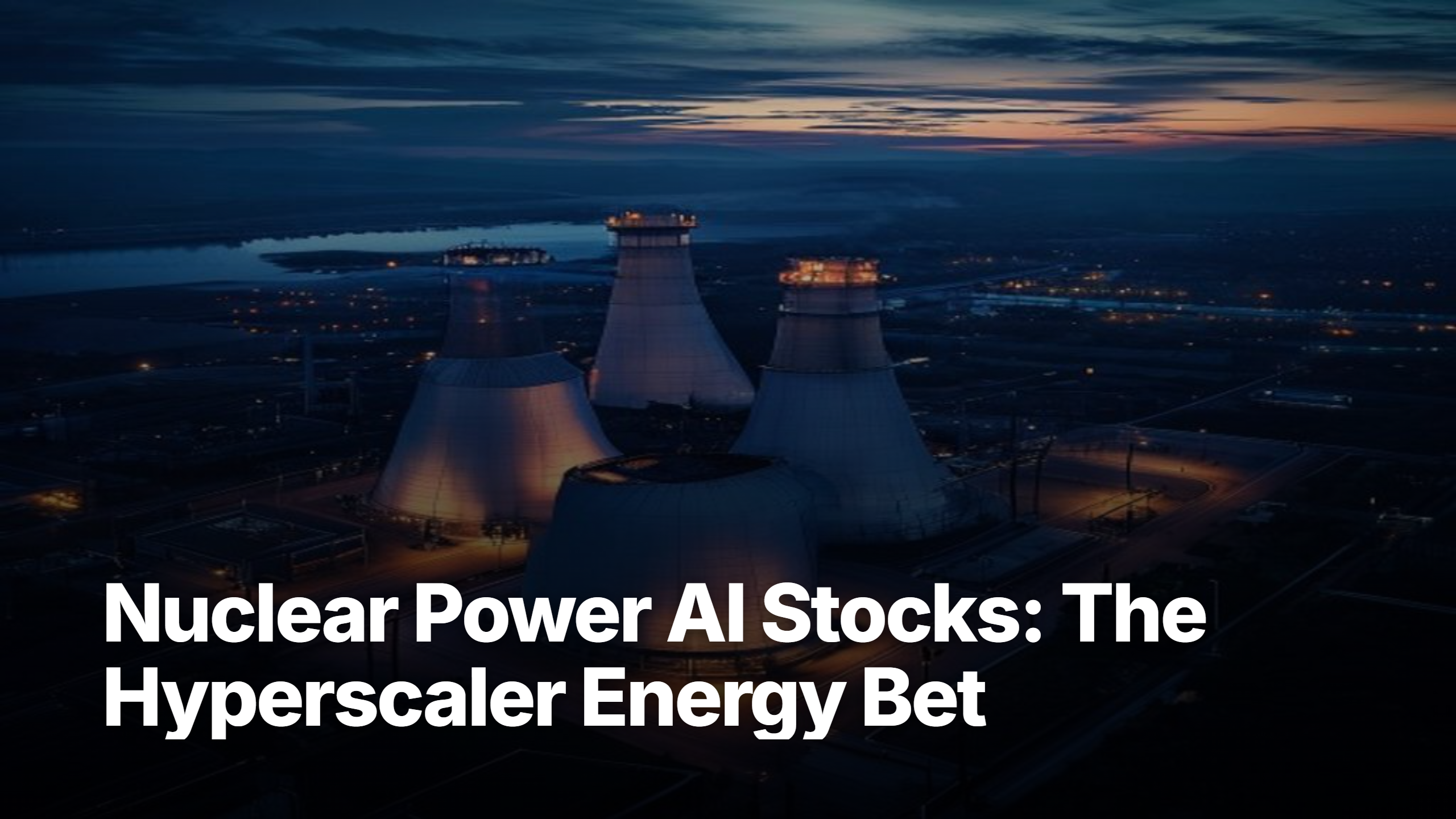
- Hyperscalers have committed $725B in 2026 data-center capex — and power, not chips, is now the binding constraint on AI infrastructure.
- Nuclear is the only energy source that delivers the always-on, zero-carbon, high-density power profile a 100MW+ hyperscale campus needs — Microsoft, Amazon, Google, and Meta are already signing PPAs to lock it in.
- Three investment buckets with different risk profiles: cash-flowing utilities with PPA deals today (CEG, VST, TLN), speculative SMR pure-plays on a 5-10 year horizon (NuScale, Oklo), and nuclear infrastructure plays with revenue now (GEV, BWXT).
Nuclear power AI stocks have moved to the centre of the hyperscaler energy trade, and the catalyst is straightforward arithmetic. The Magnificent 7 has committed $725B in data-centre capital expenditure in 2026 alone — up 77% from $410B in 2025. Every gigawatt of GPU compute requires roughly 1MW of continuous, uninterruptible power. Do the maths across Microsoft’s $190B, Amazon’s ~$200B, Google’s $180–190B, and Meta’s $125–145B build-out, and you arrive at a power demand projection the current grid cannot absorb quietly. The IEA flagged in April 2026 that AI-specific data-centre electricity demand will triple by 2030. The binding constraint is no longer silicon — it’s watts.
Constellation Energy — ticker CEG — last printed $293.60 going into publication on May 20, 2026. The stock reached an all-time high of $412 in October 2025 on the strength of the nuclear PPA wave before pulling back from those highs; Constellation closed a $16.4B acquisition of Calpine in January 2026, adding significant gas and renewables capacity alongside its 21-reactor nuclear fleet. It remains the most closely watched name in the cash-flowing utility bucket as the direct counterparty on the Microsoft TMI power purchase agreement.
The AI data centre energy problem — and why nuclear solves it
The conventional answer to data-centre power demand was always “build more renewables.” That answer breaks down at hyperscale for three structural reasons.
First, intermittency. Solar panels don’t generate at 2am. Wind doesn’t blow on demand. A 100MW campus running H100 clusters at full tilt cannot wait for the weather. The workaround — massive battery storage — adds cost, land, and its own supply-chain constraints without solving the multi-day low-generation window problem.
Second, land footprint. A 100MW solar farm requires roughly 800–1,000 acres. Utility-scale wind is worse. Data-centre campuses prefer 50–200 acre sites near fibre corridors and skilled labour markets. The land maths don’t resolve.
Third, and most important for the hyperscalers specifically: carbon commitments. Microsoft has a net-zero 2030 target. Google has committed to 24/7 carbon-free energy by 2030. Meta and Amazon have made equivalent pledges. Natural gas is fast to build — a gas peaker typically comes online in 18–36 months versus 5–8 years for a new SMR — but it fails the carbon test for any hyperscaler with a public sustainability commitment. You cannot build a gas plant in 2025 and credibly claim net-zero operations by 2030.
Nuclear checks every box the other sources miss: always-on (capacity factor ~90–93% vs ~25% for solar), zero-carbon at the point of generation, extremely high energy density per unit of land, and scalable in modular blocks. Small modular reactors extend this further — NuScale’s uprated design delivers 77 MWe per module; GE Hitachi’s BWRX-300 delivers 300 MWe — meaning a campus can contract for exactly the capacity it needs rather than building an entire gigawatt-class plant.
The timeline gap is the core tension. Existing nuclear plants can be restarted within 2–3 years if the infrastructure is intact (Three Mile Island proved this). New SMRs are 5–8 years from licence to first power, best case. That creates a two-speed market that maps directly onto the investment thesis.
How hyperscalers are locking in nuclear power
The PPA wave is the mechanism. Each deal announced re-rates the utility involved and validates the broader thesis.
Microsoft – Constellation Energy (Three Mile Island). In September 2024, Microsoft and Constellation announced a 20-year power purchase agreement for the restart of Three Mile Island Unit 1, renamed the Crane Clean Energy Center. Target in-service: 2028. The deal is the clearest template for the hyperscaler nuclear playbook: a long-duration, fixed-price PPA for a specific plant, providing Microsoft with guaranteed 24/7 carbon-free power and Constellation with the revenue certainty to justify the restart capital expenditure.
Amazon/AWS – Talen Energy (Susquehanna). AWS acquired Talen Energy’s Cumulus Data campus for $650M (closed March 2024), co-located adjacent to the Susquehanna nuclear plant in Pennsylvania, with a PPA for 960MW of carbon-free power. Note the regulatory wrinkle: FERC rejected Talen’s application for an expanded interconnection service agreement in November 2024, limiting the co-located nuclear power to the first 300MW under the existing ISA. The remaining 660MW is a live regulatory question. This is a real bear-case data point for TLN specifically.
Meta. Meta has announced partnerships with Vistra, Oklo, and TerraPower to secure up to 6.6 GW of nuclear capacity by 2035 — a notably aggressive commitment that includes both operating utilities and pre-revenue SMR developers.
Google. Google has been signing PPAs with multiple nuclear operators through 2025–26, consistent with its 24/7 carbon-free energy commitment.
Across all these deals, hyperscalers are paying a significant premium over spot electricity prices for nuclear PPAs, driven by the 24/7 reliability and zero-carbon attributes. The specific pricing is not publicly disclosed in any of these agreements, but the willingness to pay premium rates for long-duration certainty is what makes the utility re-rating thesis work.
| Hyperscaler | Nuclear counterparty | MW committed | Timeline |
|---|---|---|---|
| Microsoft | Constellation Energy (TMI/Crane) | 835 MW | PPA Sep 2024; online 2028 |
| Amazon/AWS | Talen Energy (Susquehanna) | 300 MW (operating); 960 MW total under negotiation | Campus acquired Mar 2024 |
| Meta | Vistra + Oklo + TerraPower | Up to 6,600 MW | By 2035 |
| Multiple operators | Undisclosed | 2025–26 signings |
Where the money flows: three buckets of nuclear power AI stocks
The nuclear power AI stock universe spans three fundamentally different risk-return profiles. Conflating them is the most common mistake in coverage of this theme.
| Bucket | Company / Ticker | Revenue today? | Nuclear type | Risk level | Thesis |
|---|---|---|---|---|---|
| 1 — Cash-flowing utilities | Constellation Energy (CEG) | Yes | Operating fleet (21 reactors) | Moderate | Largest US nuclear operator; Microsoft TMI deal; direct PPA wave beneficiary |
| Vistra (VST) | Yes | Nuclear + gas portfolio | Moderate | Texas grid tightness + Meta partnership; data-centre exposure via ERCOT | |
| Talen Energy (TLN) | Yes | Operating (Susquehanna) | Moderate-high | AWS campus deal; re-rated on PPA news; FERC ISA rejection is the bear case | |
| Entergy (ETR) | Yes | Nuclear-heavy utility | Low-moderate | Less direct data-centre exposure; grid tightness beneficiary | |
| 2 — SMR pure-plays | NuScale Power (SMR) | No | SMR (77 MWe/module, NRC approved) | Very high | First NRC-certified SMR design; licensing moat; UAMPS cancellation shows demand risk |
| Oklo (OKLO) | No | Microreactor (Aurora design) | Speculative | Sam Altman-backed investor; NRC pre-application phase; Meta partnership announced | |
| Nano Nuclear Energy (NNE) | No | Microreactor (early stage) | Highly speculative | Very early stage; warrant on the sector | |
| 3 — Infrastructure plays | GE Vernova (GEV) | Yes | Turbines + grid infrastructure | Lower beta | Picks-and-shovels of nuclear buildout; less binary than SMR pure-plays |
| BWX Technologies (BWXT) | Yes | Reactor component manufacturing | Lower beta | Government + commercial nuclear contracts; revenue today |
Bucket 1 — Near-term, cash-flowing (low-to-moderate risk). These are utilities that already operate nuclear plants and are signing or have signed data-centre PPAs. The investment thesis is visible revenue: CEG has the Microsoft TMI deal locked, VST has Meta exposure and ERCOT grid tightness working in its favour, TLN was re-rated sharply on the AWS Susquehanna campus deal. The risk is regulatory (the FERC ISA rejection is a live example), not existential. CEG is the clearest expression of this bucket — 21 reactors, the largest US nuclear fleet, revenue now.
Bucket 2 — SMR pure-plays (high risk, 5–10 year option). NuScale has the first NRC-certified SMR design (certification effective January 2023), which is a real regulatory moat. But the UAMPS project cancellation in November 2023 demonstrated that NRC approval doesn’t guarantee commercial demand — the economics still have to work. NuScale is pre-revenue. Oklo (OKLO) is earlier still: the company completed NRC pre-application readiness assessment Phase 1 in 2025 but has not yet filed a combined licence application. Sam Altman stepped down as board chair in April 2025 (conflict of interest with OpenAI) but remains an investor. Nano Nuclear Energy (NNE) is earlier than either — treat it as a warrant on the sector theme, not an operating business. These are 5–10 year options with meaningful binary risk.
Bucket 3 — Nuclear infrastructure plays (lower beta, longer runway). GE Vernova (GEV) supplies turbines and grid infrastructure for the nuclear buildout — less binary than the SMR pure-plays because the revenue case doesn’t depend on any single reactor design winning. BWX Technologies (BWXT) manufactures reactor components under both government and commercial nuclear contracts and generates revenue today. Both offer nuclear exposure with meaningfully less single-catalyst risk than the Bucket 2 names.
ETF proxies for investors who prefer sector exposure without single-name risk: the Range Nuclear Renaissance ETF (NUKZ) and VanEck Uranium+Nuclear ETF (NLR) both provide diversified access to the theme.
What could go wrong — the bear case for nuclear power AI stocks
The bull case is straightforward and well-covered. The bear case deserves equal airtime.
SMR timelines keep slipping. NuScale’s UAMPS cancellation is the canonical example: the company had the first NRC-approved design in the US and still couldn’t close a commercial project. The reasons were economic — cost projections rose, subscriber commitments fell short — not regulatory. The lesson is that regulatory approval is necessary but not sufficient. If SMR economics don’t pencil out against a gas peaker at current natural gas prices, the CFO’s calculus is straightforward.
Gas wins on speed. A gas peaker comes online in 18–36 months. A new SMR is 5–8 years minimum, and that assumes no NRC delays on new licence applications, which is not a safe assumption. CFOs under pressure to deliver AI compute capacity on an 18-month roadmap may choose speed over ideological carbon consistency, particularly if their sustainability commitments have flexibility in the fine print.
Regulatory risk is real. The FERC ISA rejection for Talen’s expanded Susquehanna co-location is a live example. NRC licensing for new SMR designs (Oklo, Kairos Power) remains a slow and uncertain process — the ADVANCE Act (signed July 9, 2024) streamlines some of the process, but it doesn’t eliminate the underlying complexity of licensing novel reactor designs.
Demand risk: AI capex could decelerate. The $725B capex commitment is real, but hyperscaler capex cycles have digestion phases. If AI revenue growth disappoints against the infrastructure investment, CFOs will slow the build-out. The power demand projections reset with the capex projections. Bucket 2 names (pre-revenue SMR plays) are most exposed to this scenario.
Catalysts and signals to watch
For investors tracking this theme, the signals that matter are:
- NRC SMR licence decisions — Oklo and Kairos Power are the names to watch. A combined licence application filing by Oklo would be a material catalyst for OKLO specifically.
- Hyperscaler earnings calls Q2/Q3 2026 — capex guidance updates are the primary demand signal. Any reduction in build-out pace changes the power demand math.
- New nuclear PPA announcements — each deal re-rates the relevant Bucket 1 utility. Watch CEG, VST, and TLN guidance on their PPA pipelines specifically.
- ADVANCE Act implementation — the NRC is in the process of implementing the streamlined licensing provisions signed into law in July 2024. Progress here directly affects Bucket 2 timelines.
- FERC ISA decisions on co-located nuclear power — the Talen/Susquehanna precedent means every future co-location deal faces the same regulatory scrutiny. Watch for FERC policy guidance on how it treats direct nuclear-to-data-centre connections.
The nuclear power AI stocks theme is not monolithic. Bucket 1 utilities offer visible near-term revenue and moderate risk. Bucket 2 SMR pure-plays are long-dated options on a technology timeline that has repeatedly slipped. Bucket 3 infrastructure names provide exposure with lower binary risk. Which bucket fits depends entirely on your time horizon and risk tolerance — not on whether the energy transition is “real,” which it clearly is.
Get early access to Orbit
Orbit is Luna3.ai’s AI-augmented research engine. 12 algorithmic signals + a gradient-boosted ML model + an agentic LLM that reads each top pick’s filings and writes a daily thesis with conviction score and catalyst proximity. Three regimes, three playbooks — growth in expansion, defensives in late-cycle, recovery plays at panic bottoms. The 3 in Luna3.ai.
No spam. Unsubscribe any time.
No comments yet. Be the first to share your thoughts!