
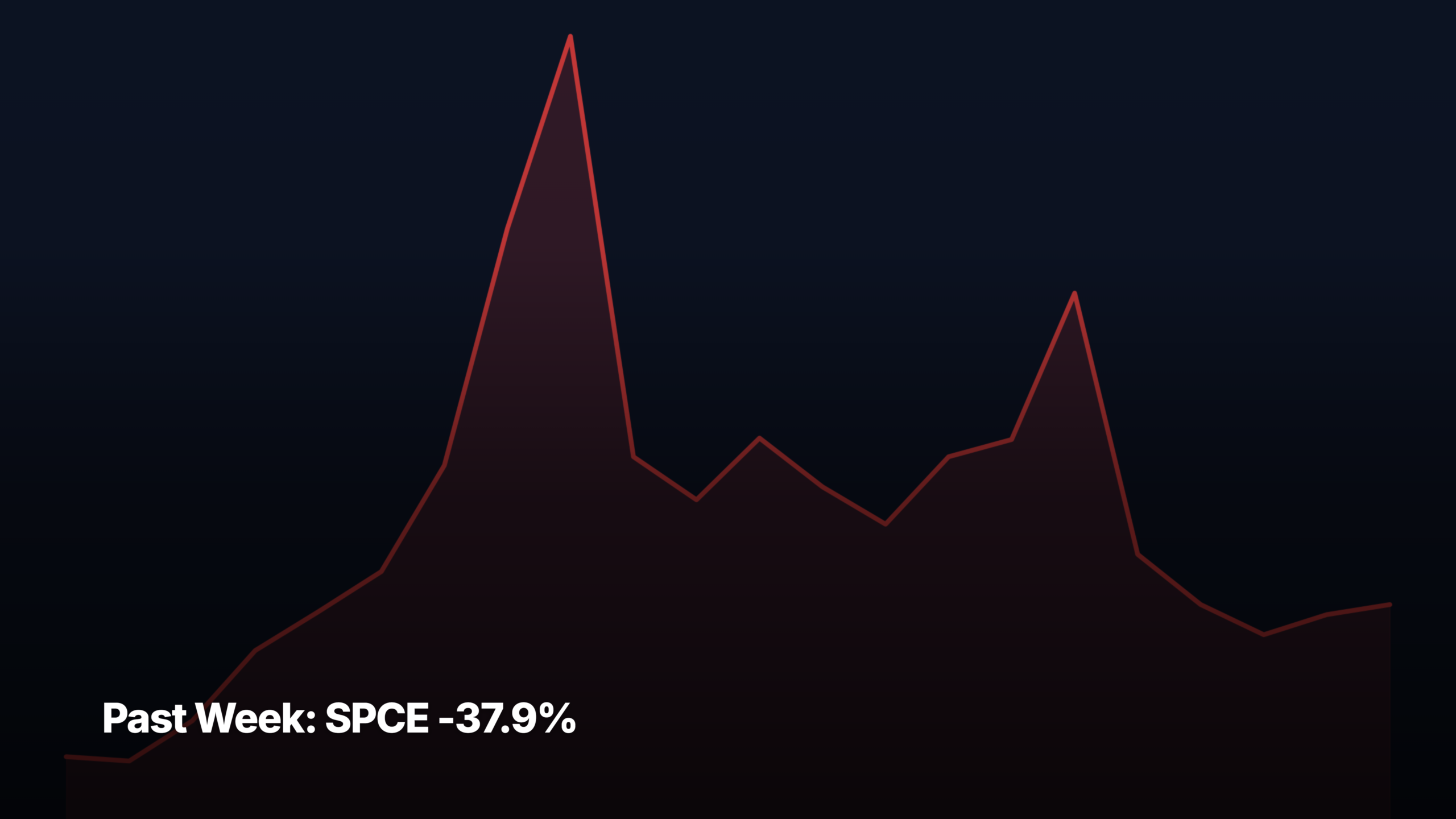
- SPCE -37.9% was the biggest decliner across all cap tiers over the past week through June 18, 2026.
- Top gainer: FCEL +35.9% (mid-cap). Top decliner: SPCE -37.9%.
- Return spread between the biggest gainer and biggest loser across all tiers was 73.8 percentage points — wide dispersion.
These are the top stock movers for the past week through June 18, 2026, broken down by market-cap tier. SPCE -37.9% was the single biggest move across all four tiers. For each tier, the top 3 gainers and top 3 decliners are listed with a plain-English catalyst note and a pattern-recognition read — whether the move looks like a clean breakout, momentum continuation, mean-reversion bounce, or extended run with reset risk.
Universe: ~145 curated US common stocks (NYSE + Nasdaq, ≥$300M market cap, ≥$1M average daily dollar volume). Cap tier reflects current market cap, not historical.
Mega-cap leaders (above $200B market cap)
Top gainers — past week
1. ↑ AMD +10.02%
$537.37 · avg $17,260M/day · Mega-cap
Why: AMD rode a fresh wave of AI chip enthusiasm as analysts increasingly framed it as the preferred alternative to Intel for data-center compute. Sell-side notes grouping AMD with Nvidia, Broadcom, and Micron as the cleaner AI exposure pulled buyers back in, layered on top of broader hyperscaler capex headlines reinforcing strong GPU demand.
Pattern: Clean continuation breakout from a multi-week base above $488, closing near the weekly high on expanding volume. Structure looks like institutional re-accumulation rather than retail chase, though a near-vertical push into resistance leaves room for a brief pause before the next leg.
2. ↑ AVGO +6.69%
$411.35 · avg $13,892M/day · Mega-cap
Why: Broadcom benefited from coverage spotlighting its custom-silicon wins with Google, Meta, Anthropic, and OpenAI, plus the framing of AVGO as the cheapest mega-cap AI name on forward earnings. Hyperscaler capex headlines about defense-budget-scale AI spend reinforced the demand story for its ASIC and networking franchises.
Pattern: Steady stair-step grind higher with shallow intraday pullbacks — classic institutional accumulation pattern. Less extended than AMD; price is pushing into prior highs but volume profile suggests room before exhaustion. Trend remains intact unless it loses the $400 shelf.
3. ↑ JPM +3.74%
$325.22 · avg $3,846M/day · Mega-cap
Why: JPMorgan caught a bid alongside headlines about its large AI operational rollout with Anthropic, framing the bank as a leader in productivity-driven cost takeout. A Fed meeting that held rates and pushed back on near-term cuts also helped large banks by preserving net interest margins for longer than dovish scenarios implied.
Pattern: Tight, low-volatility advance hugging the upper Bollinger band — a defensive money-center pattern rather than momentum chase. Move is modest and orderly; no signs of distribution. Reset risk is mild given how compressed the weekly range has been.
Top decliners — past week
1. ↓ ADBE -10.80%
$195.16 · avg $2,760M/day · Mega-cap
Why: Adobe took its biggest hit on a cautious Q2 outlook that reignited fears its core creative business is being eaten by generative AI rather than augmented by it. Citi cutting its price target and skeptical commentary from Cramer compounded the AI-disruption narrative that has dogged the stock for months.
Pattern: Decisive breakdown through prior support on heavy volume — looks like distribution rather than a normal pullback. Pattern resembles a trending decline with no clear bounce attempt yet. Oversold short-term, but structural damage suggests rallies likely get sold until management resets expectations.
2. ↓ CVX -6.56%
$173.63 · avg $1,898M/day · Mega-cap
Why: Chevron sold off as crude pulled back on easing Middle East geopolitical risk premiums, with reports flagging that markets were ‘supported as geopolitical risks recede’ — bearish for oil. The pullback was sector-wide rather than company-specific, with no negative news directly tied to Chevron’s operations.
Pattern: Sharp single-week reversal off recent highs, breaking the short-term uptrend line. Looks like a macro-driven mean reversion rather than fundamental damage. Watch the prior breakout shelf near $170 — a hold there keeps the longer base intact; a break opens room toward the next demand zone.
3. ↓ XOM -6.00%
$137.81 · avg $3,518M/day · Mega-cap
Why: Exxon moved in lockstep with Chevron as the energy complex repriced lower on a fading geopolitical risk premium. No company-specific catalyst — coverage focused on Exxon’s longer-term cost-discipline strategy, which is supportive but didn’t drive this week’s move. Sector beta did the work.
Pattern: Synchronous decline with the broader energy group; chart shows a clean pullback to the rising 50-day region rather than a structural break. Pattern reads as a healthy reset within an uptrend so long as $135 holds. Below that, the weekly trend changes character.
Large-cap leaders ($10B to $200B market cap)
Top gainers — past week
1. ↑ ROKU +15.40%
$138.07 · avg $2,620M/day · Large-cap
Why: Roku rallied despite — or partly because of — Cathie Wood dumping roughly $77M in shares, with the supply pressure absorbed and reversed quickly. Underlying connected-TV ad spend commentary and rotation back into beaten-down streaming names appeared to drive the bounce, suggesting the seller was offering an entry point to other institutions.
Pattern: Sharp mean-reversion bounce off oversold levels with a strong reclaim of prior support. Volume confirms real buying rather than a short-cover spike. Move is extended on a one-week basis though, so a backfill to test the breakout would be normal before the next push.
2. ↑ INTC +14.56%
$133.99 · avg $19,380M/day · Large-cap
Why: Intel ripped on a combination of foundry-progress headlines and the same analyst note that paradoxically called its valuation indefensible — that note triggered a short squeeze as positioning was heavily bearish. Coverage hinting at Trump-administration support for domestic chip manufacturing added a policy tailwind to the move.
Pattern: Explosive breakout above a multi-month base on the heaviest volume of the period — classic squeeze characteristics. Move is extended short-term and likely needs to consolidate, but the base break itself is structurally bullish if $125 holds on the inevitable pullback.
3. ↑ QCOM +11.41%
$226.11 · avg $4,695M/day · Large-cap
Why: Qualcomm joined the broad semiconductor rally as money rotated into AI-adjacent chip names beyond Nvidia. The 6.2% single-session jump cited in headlines reflected catch-up buying as investors looked for cheaper ways to play edge AI and smartphone-AI silicon, even as some analysts flagged the move as stretching valuation.
Pattern: Clean breakout from a tight range with momentum confirmation. Pattern fits a sector-rotation chase more than a stock-specific re-rating. Near-term extended; if semis cool, QCOM is likely to give back a chunk before resuming. Key level to watch: the breakout pivot around $215.
Top decliners — past week
1. ↓ ACN -23.60%
$127.98 · avg $1,788M/day · Large-cap
Why: Accenture cratered after a cautious Q2 outlook spotlighting slower IT-services demand and concerns that gen-AI is compressing the consulting-hours business model. The fear is structural: clients use AI tools to do work Accenture used to bill for. That re-rated the multiple sharply lower in a single session.
Pattern: Violent gap-down through multiple support levels on the heaviest volume in years — textbook distribution. Pattern signals a regime change, not a tradable dip. Even with the magnitude of the drop, rallies likely get sold until forward guidance is reset and the gen-AI revenue offset becomes visible.
2. ↓ SNAP -12.57%
$4.66 · avg $319M/day · Large-cap
Why: Snap weakened as it spun off its generative AI video unit into a separate company called Dotmo, which markets read as management acknowledging the core ad business can’t fund AI investment alongside operations. Cramer’s ‘cemented itself as a disappointment’ line and renewed child-safety regulatory chatter piled on.
Pattern: Drift lower with no buyer interest near multi-month lows — trending decline with low conviction on either side. The penny-stock-adjacent price action looks like investor capitulation more than panic. Until volume returns on the upside, base-building takes time.
3. ↓ IBM -9.37%
$249.10 · avg $2,084M/day · Large-cap
Why: IBM gave back gains as quantum-computing enthusiasm rotated toward Amazon’s quantum push and pure-play names like IonQ and Rigetti. No IBM-specific negative news — this looks like profit-taking after a strong run, plus narrative migration away from incumbent quantum players toward smaller, more leveraged plays.
Pattern: Sharp pullback after an extended advance — looks like a normal reset within an uptrend rather than a top. The breakdown from recent highs needs to hold the $245 region to keep the longer base intact. Mean-reversion bounce attempt likely before direction resolves.
Mid-cap leaders ($2B to $10B market cap)
Top gainers — past week
1. ↑ FCEL +35.90%
$24.04 · avg $221M/day · Mid-cap
Why: FuelCell Energy popped without a clear company-specific catalyst — no single clear catalyst, with the most plausible explanation being a broader rotation back into clean-energy and hydrogen names alongside speculative small-cap risk appetite. Fuel-cell stocks have historically traded together on thematic flow, and the move’s magnitude is consistent with momentum-trader piling into a low-float beta name.
Pattern: Vertical thrust off a depressed base with no fundamental anchor — classic low-float momentum spike. Moves like this rarely hold without follow-through volume; reset potential is high. Watch the $20 prior-resistance level to see if it converts to support or fails on the first pullback.
2. ↑ AMC +24.12%
$2.83 · avg $147M/day · Mid-cap
Why: AMC surged on record May attendance numbers driven by a stronger summer box-office slate, paired with a $150M equity raise that markets interpreted as opportunistic rather than dilutive distress. Coverage debating whether the fundamental bull case had actually shifted kept retail attention engaged, fueling the squeeze-style move.
Pattern: High-volume meme-stock-style spike off basing levels — looks like a momentum chase rather than a clean breakout. The equity raise caps near-term upside as fresh supply hits the float. Reset potential is meaningful once the box-office headline cycle cools.
3. ↑ HIMS +22.86%
$35.47 · avg $754M/day · Mid-cap
Why: Hims & Hers rallied into a July FDA decision that could expand its weight-loss telehealth franchise, with longevity and consumer-health narratives drawing fresh attention to the name. Investor search interest spiked, suggesting retail accumulation joined institutional positioning ahead of the binary catalyst.
Pattern: Strong trending advance with each pullback getting bought — momentum structure remains intact. The looming FDA date creates event-driven volatility risk on both sides; pattern is extended short-term but the binary catalyst makes traditional reset rules less applicable. Size accordingly.
Top decliners — past week
1. ↓ DKNG -12.09%
$26.39 · avg $346M/day · Mid-cap
Why: DraftKings sold off without a single clean catalyst — no single clear catalyst, most plausibly profit-taking after a 12% three-month run with some commentary pieces flagging caution on the growth-stock cohort. State-level gambling regulatory chatter has been a recurring overhang for the sector and likely contributed to the soft tape.
Pattern: Pullback from recent highs that broke the short-term uptrend line. Pattern looks like a healthy reset within a longer uptrend if $25 holds. Below that, the weekly structure changes character and the bigger base comes back into play.
2. ↓ FUBO -11.94%
$9.22 · avg $16M/day · Mid-cap
Why: Fubo continued lower after Cramer flagged streaming sports as a ‘secular decline’ industry, reinforcing the bear case that subscriber growth can’t outrun content costs. With no offsetting positive catalyst and a small float, the negative commentary was enough to pull the stock to fresh lows.
Pattern: Trending decline with no bounce attempts — looks like slow distribution rather than capitulation. The lack of buyer interest at recent lows signals base-building will take time. Until volume returns, mean-reversion setups are low-probability here.
3. ↓ MNDY -10.12%
$71.53 · avg $122M/day · Mid-cap
Why: monday.com drifted lower on elevated investor attention with no positive catalyst to anchor it — no single clear catalyst, most plausibly part of the broader software-stock derating as gen-AI raises questions about workflow-tool stickiness. The Accenture warning likely amplified the read-through risk to enterprise software demand more broadly.
Pattern: Clean break of the short-term trend with a measured decline rather than a panic flush. Pattern looks like an early-stage distribution phase. Watch the $70 area — a hold there keeps the longer base intact; a break puts the prior breakout zone in play as a target.
Small-cap leaders ($300M to $2B market cap)
Top gainers — past week
1. ↑ CIFR +28.94%
$29.18 · avg $704M/day · Small-cap
Why: Cipher Mining caught the AI-infrastructure pivot bid as commentary highlighted Bitcoin miners as the cheapest way to play the roughly $50B funding gap VanEck identified in data-center buildouts. Miners with surplus power capacity are increasingly framed as HPC-hosting plays, and CIFR is one of the cleaner names in that narrative.
Pattern: Powerful breakout from a multi-month consolidation on expanding volume — classic base-and-breakout pattern. The narrative-driven flow can extend the move further, but the size of the weekly gain leaves it short-term extended. A backfill to test the breakout pivot would be normal.
2. ↑ CHPT +26.29%
$8.31 · avg $5M/day · Small-cap
Why: ChargePoint rallied on no clear company-specific news — no single clear catalyst, most plausibly a low-float momentum bid as commentary highlighted relative strength versus the auto-tech cohort. EV-charging names have been deeply out of favor, so positioning is short and any positive flow gets amplified.
Pattern: Sharp bounce off washout lows on light dollar volume — classic oversold mean-reversion in a beaten-down name. The thin liquidity ($5M average daily dollar volume) means the move can reverse just as quickly. Reset potential is high without a follow-through catalyst.
3. ↑ BTBT +25.43%
$2.17 · avg $69M/day · Small-cap
Why: Bit Digital rode the same Bitcoin-miner-as-AI-infrastructure narrative that lifted CIFR, with elevated investor search interest pulling retail flow into the name. The thesis is that miners can repurpose facilities and power agreements into HPC hosting — a much higher-margin business than mining itself.
Pattern: Sharp bounce off a sub-$2 base on outsized volume relative to recent averages. Pattern reads as speculative narrative-chase more than structural accumulation. The low absolute price and thin float make this prone to violent two-way moves; reset potential remains elevated.
Top decliners — past week
1. ↓ SPCE -37.87%
$3.56 · avg $209M/day · Small-cap
Why: Virgin Galactic collapsed as SpaceX’s IPO momentum ‘sucked the oxygen’ out of the rest of the space-trade complex, with shorts piling into SPCE specifically as the weakest fundamental story in the group. With no commercial flight cadence to defend the name, the narrative damage translated directly into supply.
Pattern: Severe trending decline with no demand zone visible — distribution pattern, not a tradable bounce setup yet. The magnitude of the weekly drop is extreme even by SPCE’s volatile standards; an oversold relief bounce is possible but the structural trend remains broken until proven otherwise.
2. ↓ ASTS -17.32%
$80.66 · avg $2,688M/day · Small-cap
Why: AST SpaceMobile sold off on the SpaceX-IPO read-through, with shorts piling in alongside SPCE. The BlueBird launch headlines were framed as a critical test for the direct-to-device thesis rather than a confirmed win, leaving the market in wait-and-see mode while the SpaceX competitive overhang did the damage.
Pattern: Sharp pullback from recent highs that broke the short-term uptrend on heavy volume. Pattern looks like a reset within a longer uptrend rather than structural distribution given the underlying narrative is intact. Watch the $75 region as the next demand zone test.
3. ↓ ONDS -5.70%
$9.27 · avg $517M/day · Small-cap
Why: Ondas slipped mildly despite announcing its sixth acquisition of the year — the Cyberhawk deal expanding its critical-infrastructure drone footprint. The decline likely reflects acquisition-fatigue concerns and dilution worries rather than dissatisfaction with strategy. Comparison coverage versus competitor RCAT split investor attention.
Pattern: Shallow pullback within an otherwise constructive base — the small magnitude of the decline suggests no real distribution, just consolidation. Pattern remains intact for a continuation attempt if the broader drone-tech complex catches a bid. The $9 area is the key support to defend.
What the past week cohort tells us
Mega-cap and large-cap winners both clustered in semiconductors (AMD, AVGO, INTC, QCOM), confirming that the AI hardware trade has broadened beyond Nvidia into the second-tier silicon names — a healthy sign of leadership rotation rather than narrow concentration. The most striking dispersion was in services: Accenture’s -23.6% collapse alongside Adobe’s -10.8% drop signals the market is finally pricing gen-AI as a destroyer of consulting and creative-software revenue, not just an enabler. Small-cap winners (CIFR, BTBT) tied to crypto miners pivoting toward AI infrastructure suggest risk appetite is alive at the speculative end, while energy names (CVX, XOM) sold off on a fading geopolitical risk premium — a classic risk-on tape. Return dispersion is wide (FCEL +35.9% to SPCE -37.9%, a 74-point spread), which signals stock-picking matters more than index direction here. Forward read: the gen-AI disruption narrative is starting to bifurcate winners and losers along the line of who sells AI infrastructure versus who sells billable hours that AI replaces — expect that divide to deepen into Q3 earnings.
Bottom line
The top stock movers recap covers every US market-cap tier from mega ($200B+) to small ($300M-$2B). The Past Week view shows sustained leadership and sector rotation — complementary to the daily session recap (single-session moves, Tue-Sat morning Melbourne time).
Get early access to Orbit
Orbit is Luna3.ai’s AI-augmented research engine. 12 algorithmic signals + a gradient-boosted ML model + an agentic LLM that reads each top pick’s filings and writes a daily thesis with conviction score and catalyst proximity. Three regimes, three playbooks — growth in expansion, defensives in late-cycle, recovery plays at panic bottoms. The 3 in Luna3.ai.
No spam. Unsubscribe any time.
No comments yet. Be the first to share your thoughts!