
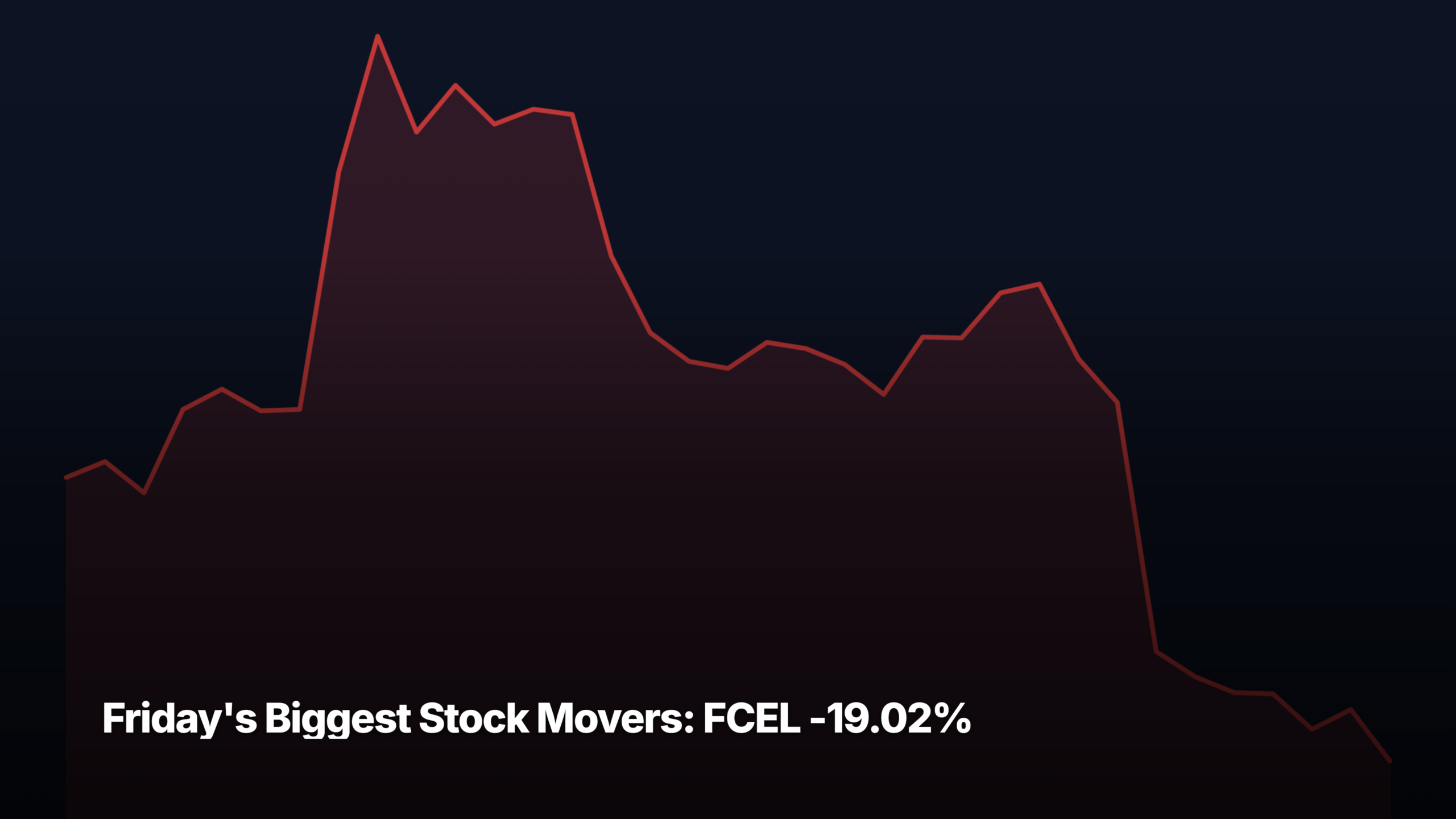
- FCEL -19.02% was the single biggest move across all cap tiers — led the downside on the mid-cap tier.
- Two-way tape — 3 cap tiers had an up-mover and 4 had a down-mover.
- Spread between the biggest up and biggest down move was 23.1 percentage points — wide dispersion.
These are the biggest stock movers from Friday’s US session (June 5, 2026) — one up and one down for each market-cap tier. FCEL -19.02% led overall in the mid-cap bucket. Each ticker block has the catalyst (or an honest “no clear catalyst” if there isn’t one) plus what a pattern-recognition algorithm would actually flag in the move — base breakout, momentum continuation, failed breakdown, sympathy selloff, or noise.
Mega-cap movers (Companies above $200B)
↑ PG +4.09%
$146.54 · Mega-cap · $1.6B traded
Why: Classic defensive rotation as Nasdaq plunged 1,100 points on renewed rate hike concerns — money moved into stable dividend aristocrats like Procter & Gamble as a safe haven.
Pattern: Textbook risk-off rotation trade with strong dollar volume confirming institutional participation. Not a breakout from a base — more of a macro-driven mean-reversion bid into defensives.
↓ AMD -10.86%
$466.38 · Mega-cap · $21.3B traded
Why: Caught in the broad Nasdaq selloff driven by renewed rate hike fears, with semis and AI-adjacent names hit hardest as traders de-risked high-beta growth positions.
Pattern: Massive $21B dollar volume signals institutional liquidation, not retail noise. After a strong run, this looks like a momentum reversal on volume — watch whether prior support holds or breaks.
Large-cap movers ($10B to $200B)
↑ MCD +2.61%
$279.84 · Large-cap · $1.1B traded
Why: Defensive rotation lifted consumer staples and fast-food names as the Nasdaq sold off hard — McDonald’s benefits from the same flight-to-safety bid as other low-beta dividend payers.
Pattern: Modest +2.6% gain on healthy volume looks like a continuation of the defensive bid rather than a clean breakout. No base setup here — simply riding the risk-off tide.
↓ IREN -12.14%
$54.35 · Large-cap · $3.4B traded
Why: Profit-taking after a nearly 40% rally in May and 60% gain over three months — the broader tech selloff gave holders a reason to lock in gains on this data center miner.
Pattern: High-conviction giveback after parabolic run — $3.4B dollar volume on a large-cap is heavy distribution. Fits a momentum exhaustion pattern; extended names sell hardest in risk-off tape.
Mid-cap movers ($2B to $10B)
↑ GTLB +0.91%
$31.12 · Mid-cap · $255M traded
Why: Held up relatively well in a brutal tape, possibly supported by ongoing price recovery narrative and recent coverage noting its growth prospects versus GitHub competition.
Pattern: A +0.9% move on a day the Nasdaq dropped 1,100 points is notable relative strength, but the absolute move is too small to call a pattern — more like noise in a storm.
↓ FCEL -19.02%
$17.33 · Mid-cap · $183M traded
Why: Sharp reversal after a strong short-term rebound — recent coverage questioned FCEL’s valuation after the bounce, and the broad risk-off tape accelerated the pullback in speculative names.
Pattern: Classic failed-bounce pattern — sharp rebound followed by a -19% rejection on meaningful volume suggests the prior rally was short-covering, not accumulation. Sellers regained control.
Small-cap movers ($300M to $2B)
↓ BLDP -18.95%
$4.92 · Small-cap · $59M traded
Why: No clear catalyst in recent headlines — hydrogen and clean energy names sold off broadly as the risk-off tape crushed speculative small-caps with no defensive bid to lean on.
Pattern: A -19% drop on a small-cap with only $59M dollar volume fits the illiquidity trap pattern — thin order books amplify moves in risk-off sessions. Watch for dead-cat bounce attempts.
Today’s biggest stock movers — bottom line
Friday’s tape leaned red — 4 down-movers vs 3 up-movers across the cap tiers. The Movers recap drops daily Tue-Sat morning Melbourne time, covering the prior US session’s biggest stock movers in every cap tier — mega, large, mid, and small.
Read next: Daily Stock Movers · Gamma Squeeze Mechanics · What Is a P/E Ratio?
Get early access to Orbit
Orbit is Luna3.ai’s AI-augmented research engine. 12 algorithmic signals + a gradient-boosted ML model + an agentic LLM that reads each top pick’s filings and writes a daily thesis with conviction score and catalyst proximity. Three regimes, three playbooks — growth in expansion, defensives in late-cycle, recovery plays at panic bottoms. The 3 in Luna3.ai.
No spam. Unsubscribe any time.
No comments yet. Be the first to share your thoughts!