
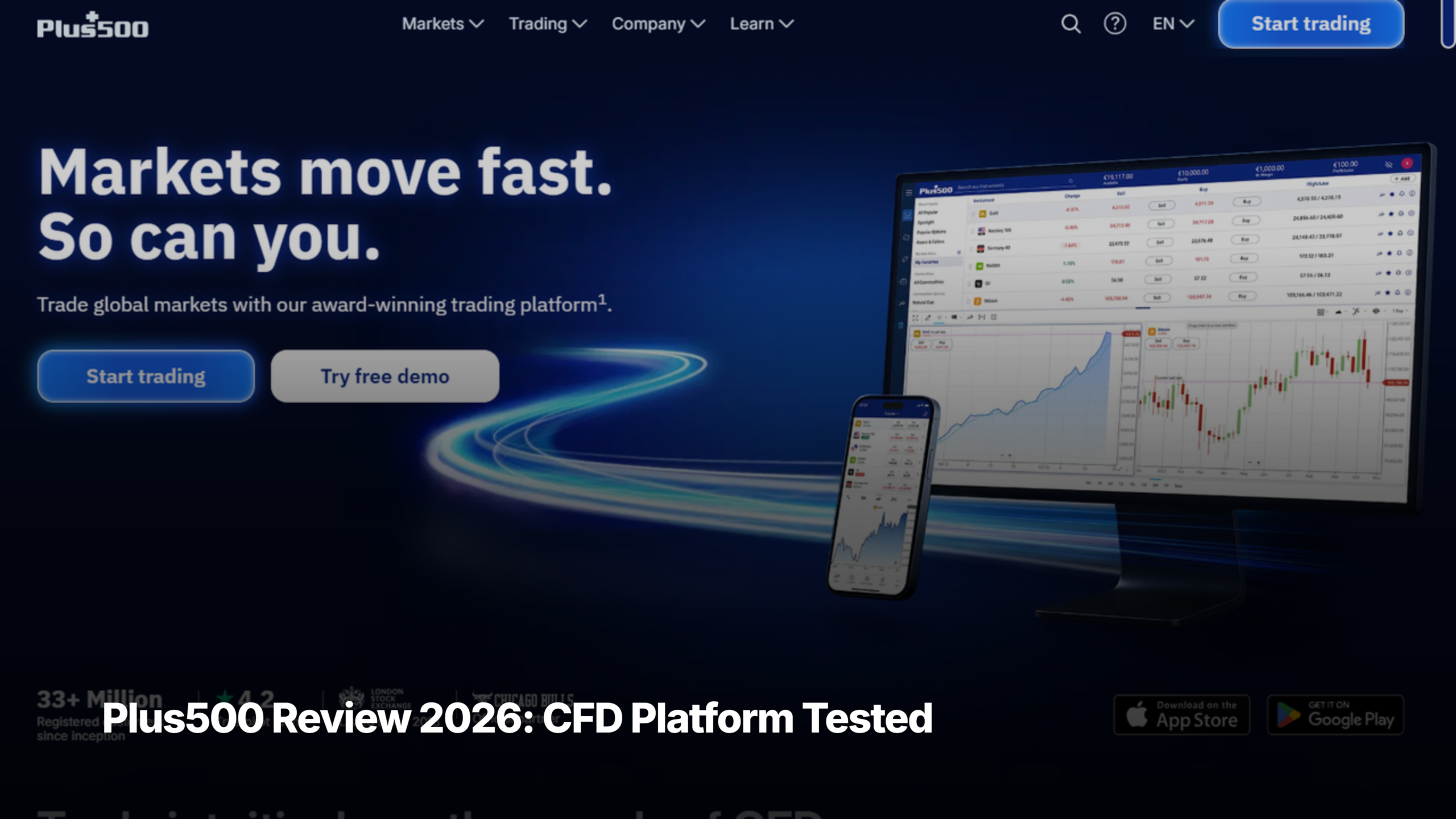
This Plus500 review covers what really matters before you open an account: how the platform actually feels in the hand, what it costs over a month of holding positions, who it’s built for, and — bluntly — who should stay away. Plus500 is one of the largest CFD platforms in the world, a FTSE 250 company on the London Stock Exchange, and a regulated broker across roughly a dozen jurisdictions. It’s also a contracts-for-difference (CFD) broker, which means leverage, overnight fees, and a regulatory risk warning that is impossible to miss: most retail accounts lose money trading CFDs. We tested the platform hands-on for this Plus500 review and the verdict is below.
- Plus500 is a regulated, FTSE 250-listed CFD platform with 2,800+ instruments — strong choice for experienced retail traders in AU/UK/EU/SG, but not available to US residents for CFDs.
- The 80% retail-account loss rate is a statutory CFD risk disclosure — not Plus500-specific, but it sets the bar for who should be on this platform at all.
- Spread-based pricing, no buy/sell commissions, and a free unlimited demo with $40,000 virtual funds — but watch overnight funding charges and the $10/month inactivity fee.
Our Plus500 review verdict
Luna3 score: 7.5 / 10. Plus500 is one of the leading CFD platforms for retail traders who already understand CFD mechanics — leverage, spreads, overnight funding — and want a clean, mobile-first platform without the complexity of a full multi-asset brokerage. It is not the place to learn what a CFD is.
Who it’s for: experienced retail CFD traders in Australia, the UK, EU, Singapore, and other supported regions who want tier-1 regulation, a wide instrument range, and a low-friction mobile experience.
Who it’s not for: US residents (CFDs are not available to US clients — only futures via Plus500US), absolute beginners, algorithmic traders who need MT4/MT5, and anyone who wants to own shares outright rather than trade their price.
80% of retail investor accounts lose money when trading CFDs with this provider. You should consider whether you can afford to take the high risk of losing your money. Full regulatory disclosures at the bottom of this review.
What Plus500 is
Plus500 is a contracts-for-difference broker. That word matters: you are not buying shares of Apple when you “trade Apple” on Plus500 — you’re entering a derivative contract that tracks the share price. There is no ownership, no voting rights, no dividends in the conventional sense (though dividend adjustments are paid on long CFD positions). What you get instead is leverage, the ability to short as easily as you can go long, and access to roughly 2,800 instruments through a single account.
The instrument range is the platform’s main pitch. Plus500 offers CFD trading in shares, indices, forex, commodities, ETFs, options, and cryptocurrencies (availability subject to regulation). Coverage spans the major US, UK, European, and Asian markets — over 60 forex pairs, the main indices (S&P 500, Nasdaq 100, ASX 200, FTSE 100, DAX, Nikkei), commodities like gold, oil and natural gas, and the larger US-listed equities.
The regulatory footprint is where Plus500 differentiates itself from offshore CFD shops. The parent, Plus500 Ltd, is a FTSE 250 company listed on the London Stock Exchange (ticker PLUS) — the 2025 annual results, reported in February 2026, showed $792.4M in revenue and $281.3M in net profit. Each regional entity is separately licensed:
- Plus500AU Pty Ltd — ASIC licence #417727 (Australia), ACN 153 301 681; also FMA NZ FSP #486026 and FSCA South Africa FSP #47546
- Plus500UK Ltd — FCA FRN #509909
- Plus500CY Ltd — CySEC #250/14 (Cyprus / EU)
- Plus500SG Pte Ltd — MAS CMS100648 (Singapore)
- Plus500US Inc — futures only, via Cunningham Commodities (CFTC / NFA #0001398) — CFDs are not available to US residents
The platform is available in more than 50 countries and 30+ languages, and Plus500 reports 33+ million registered customers since inception. Those numbers don’t tell you whether the platform is right for you, but they do put it firmly in the “real, audited, regulated” bucket — not the offshore-shell bucket that haunts CFD reviews.
What we tested
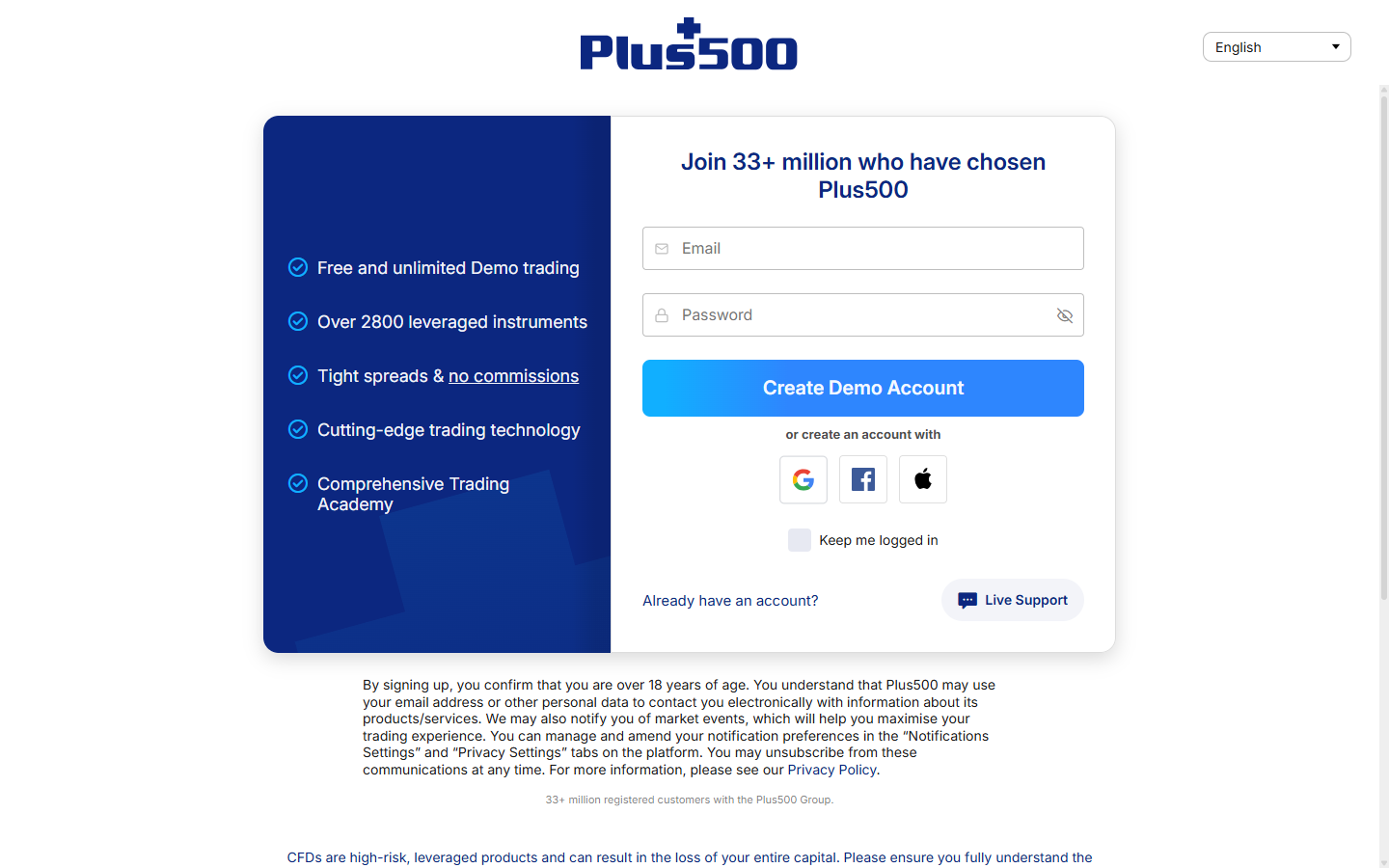
We opened a Plus500 demo account from a cold start and walked through the platform the way a new user would. The demo signup is genuinely 30 seconds: email, password, account currency, and you’re in. No phone verification, no document upload, no minimum deposit — that’s the demo’s biggest feature for serious testers. Plus500 funds the demo with $40,000 in virtual money and the account doesn’t expire, which is meaningfully better than the 14-day or 30-day demos that some competitors still ship.
Platform UI: the proprietary WebTrader
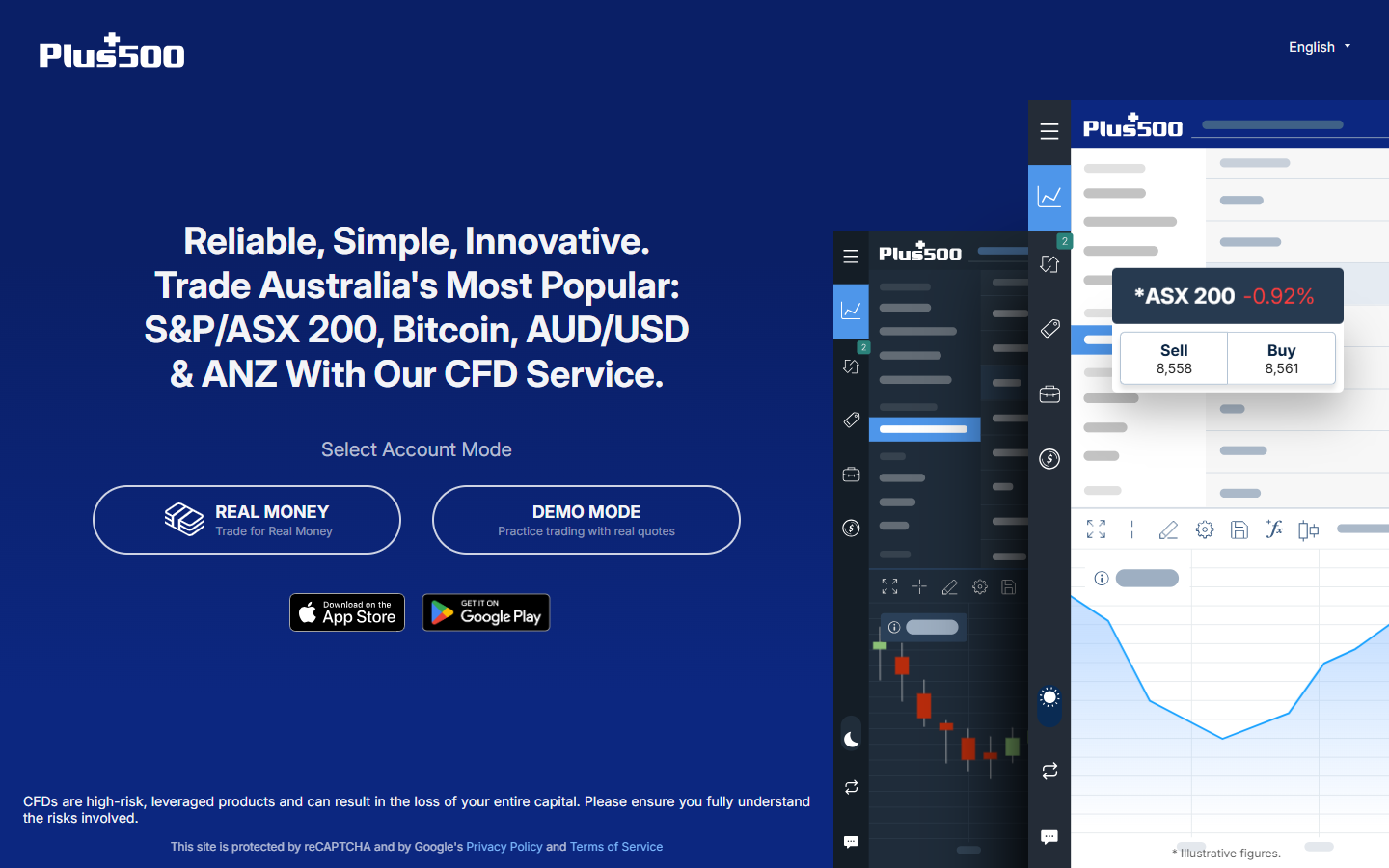
Plus500 runs a proprietary web platform plus iOS and Android apps. There is no MT4 or MT5 support, no cTrader, no third-party API for algorithmic trading. That’s a deliberate product choice — the platform is built for discretionary retail, not for systematic strategies, and the UI reflects that. The instrument list is grouped into categories (Popular, Indices, Forex, Crypto, Shares by region, Commodities, ETFs) and the order ticket sits to the right of the chart on desktop or one tap away on mobile.
The interface is clean. The sell/buy buttons are large, the bid-ask spread is shown prominently, and the order ticket asks for one decision per field — leverage, position size, stop loss, take profit, trailing stop. The platform also offers a guaranteed stop loss (a stop that cannot slip past your set level even in a gap), priced as an additional spread on the trade. For volatile instruments like crypto CFDs, that’s the feature most worth understanding before you risk a real dollar.
Charts: built-in, capable, not TradingView
The built-in charts are HTML5, smooth, and give you the standard timeframes (1m through 1W) and a respectable set of indicators (moving averages, RSI, MACD, Bollinger Bands, Fibonacci levels). Drawing tools are basic — trendlines, horizontal levels, rectangles — but functional. If you live in TradingView’s annotation toolkit, you’ll find Plus500’s charts adequate for execution but underwhelming for analysis. The honest framing: do your chart work in TradingView or StockCharts (see our TradingView vs StockCharts comparison), execute on Plus500.
Risk management tools
Three risk tools matter on a CFD platform and Plus500 ships all three: standard stop loss, trailing stop, and guaranteed stop. Negative balance protection is also in place for retail accounts in regulated jurisdictions — meaning you cannot lose more than your account balance, even in a gap event. That sounds basic but it is a hard requirement under ASIC, ESMA, FCA and CySEC rules; offshore CFD shops often skip it. Verify it’s active in your jurisdiction before funding.
Plus500 pricing in 2026
Plus500 makes its money on spreads. There are no buy/sell commissions on standard CFD trades — the spread between the buy and sell price is the cost of round-tripping a position, and Plus500 publishes it on every instrument page. Spreads are competitive for the popular instruments (EUR/USD, S&P 500, gold) and wider on the long tail. Refer to Plus500’s website for current spreads on the instruments you actually intend to trade.
What’s not free is everything else:
- Overnight funding (swap): Positions held past the daily cutoff incur a funding charge or credit, depending on direction and the underlying interest-rate differential. For positions held more than a few days, this is often the dominant cost — verify the daily charge on each instrument page before holding overnight.
- Inactivity fee: USD $10 per month after 3 consecutive months without logging in. A single login (no trade required) resets the clock.
- Currency conversion fee: If your account currency differs from the instrument’s quote currency, a conversion fee applies on the P&L.
- Withdrawals: Five free withdrawals per month. A $10 processing fee applies to withdrawal requests below the minimum threshold ($100 for bank transfers and cards, $50 for PayPal and Skrill). International bank transfers incur an additional $6 charge.
- Guaranteed stop loss: Priced as an additional spread on the affected trade — not a flat fee, but disclosed upfront on the order ticket.
- Maximum leverage: Capped by your regulatory jurisdiction. Plus500 publishes the maximum leverage per asset class on the platform — refer to their site for specifics.
The most common surprise in our testing was overnight funding. A 5x-leveraged forex position held for two weeks can easily swallow more in swap charges than the spread cost on entry and exit combined. Plus500 makes the daily figure visible — but the visibility doesn’t make the charge smaller. Day traders and short-swing traders won’t notice; position traders absolutely will.
Where it shines
- Tier-1 regulation across major jurisdictions. ASIC, FCA, CySEC, MAS and others — a real audit trail and segregated client funds. Plus500 Ltd is itself a FTSE 250-listed public company with audited financials.
- Clean, mobile-first platform. The iOS and Android apps are genuinely well-built; the desktop WebTrader is the same engine in a wider window. Execution is fast and the UI does not bury risk-management fields.
- Free, unlimited demo with $40,000 virtual funds. No deposit required, no expiry, no documents — the lowest-friction demo onramp in the regulated CFD space.
- 2,800+ instruments across asset classes. One account covers shares CFDs, indices, forex, commodities, ETFs, options, and crypto CFDs.
- Low-friction withdrawals. Five free withdrawals per month, no withdrawal processing fee above minimum thresholds, and same-day processing for cards and e-wallets in our test.
Where it falls short
- CFD-only — no share ownership. If you want to actually own Apple shares (and collect dividends, vote at the AGM, hold for years), Plus500 is not the right tool. Look at a traditional broker instead.
- Overnight funding charges add up. For positions held more than a few days, swap costs often dominate spread costs. Day traders won’t notice; position traders should model it before opening.
- No MT4 / MT5 / cTrader support. The platform is proprietary and there is no third-party API for algo strategies. For algorithmic trading, look at MT5-compatible brokers instead.
- Charting is functional, not best-in-class. Capable for execution but underwhelming if you live in TradingView’s drawing toolkit.
- Not available to US residents for CFDs. Plus500US (Cunningham Commodities) only offers futures and options on futures — the CFD product is restricted to non-US clients.
Alternatives to Plus500
If Plus500’s proprietary-only stack or the CFD-only model doesn’t fit, three alternatives are worth comparing:
- Pepperstone and IC Markets — Australia’s most active CFD and forex brokers, both ASIC-regulated, both with MT4 / MT5 / cTrader support and direct API access for algorithmic strategies. See our full Pepperstone vs IC Markets comparison for the head-to-head.
- IG Markets — broader product range that combines CFDs with share dealing (you can actually own the shares), spread betting in the UK, and a more analyst-driven research offering. Bigger account minimums and a steeper learning curve.
- eToro — social trading angle, simpler UI, copy-trading. Less suitable for traders who want full control over execution; better for users who want to follow other traders.
For investors who want to own shares rather than trade their price, the comparison shifts entirely to traditional brokers — see Fidelity vs Schwab vs Vanguard for the US side or your local equivalent.
Bottom line — should you use Plus500?
For the right user, Plus500 is one of the leading CFD platforms in the regulated space — well-built, audited, mobile-first, and surprisingly low-friction for a tier-1 broker. The platform’s $40,000 unlimited demo is the cleanest test drive in CFDs; the proprietary WebTrader is more polished than its reputation; and the 2,800-instrument range covers what a retail CFD trader actually wants to trade.
The right user is specific. They already know what a CFD is, what overnight funding does to a multi-week position, and why a guaranteed stop costs more than a standard one. They are not in the US. They don’t need MT5 or external API access. If that’s not you, the answer is to either pick a different broker (Pepperstone for algo support, IG for share ownership, a traditional broker if you want to actually buy shares) — or, if you’re new to CFDs entirely, to spend 30 days in the demo before any decision about real money.
Regulatory disclosures
80% of retail investor accounts lose money when trading CFDs with this provider. You should consider whether you can afford to take the high risk of losing your money.
CFDs are complex leveraged products and Plus500 does not provide investment advice or asset management services. Past performance is not a reliable indicator of future results.
Regulatory entities:
- Plus500AU Pty Ltd (ACN 153 301 681) holds ASIC AFSL #417727 in Australia, FMA FSP #486026 in New Zealand, and FSCA FSP #47546 in South Africa.
- Plus500UK Ltd is authorised and regulated by the Financial Conduct Authority (FRN 509909).
- Plus500CY Ltd is authorised and regulated by CySEC (Licence No. 250/14).
- Plus500SG Pte Ltd holds a capital markets services licence from the Monetary Authority of Singapore (CMS100648).
- Plus500US Inc operates futures and options on futures via Cunningham Commodities (CFTC / NFA #0001398). CFDs are not available to US residents.
Cryptocurrency availability is subject to regulation. The information in this Plus500 review is general in nature and does not consider your personal circumstances. You do not own or have any rights to the underlying assets when trading CFDs.
Get early access to Orbit
Orbit is Luna3.ai’s AI-augmented research engine. 12 algorithmic signals + a gradient-boosted ML model + an agentic LLM that reads each top pick’s filings and writes a daily thesis with conviction score and catalyst proximity. Three regimes, three playbooks — growth in expansion, defensives in late-cycle, recovery plays at panic bottoms. The 3 in Luna3.ai.
No spam. Unsubscribe any time.
No comments yet. Be the first to share your thoughts!