
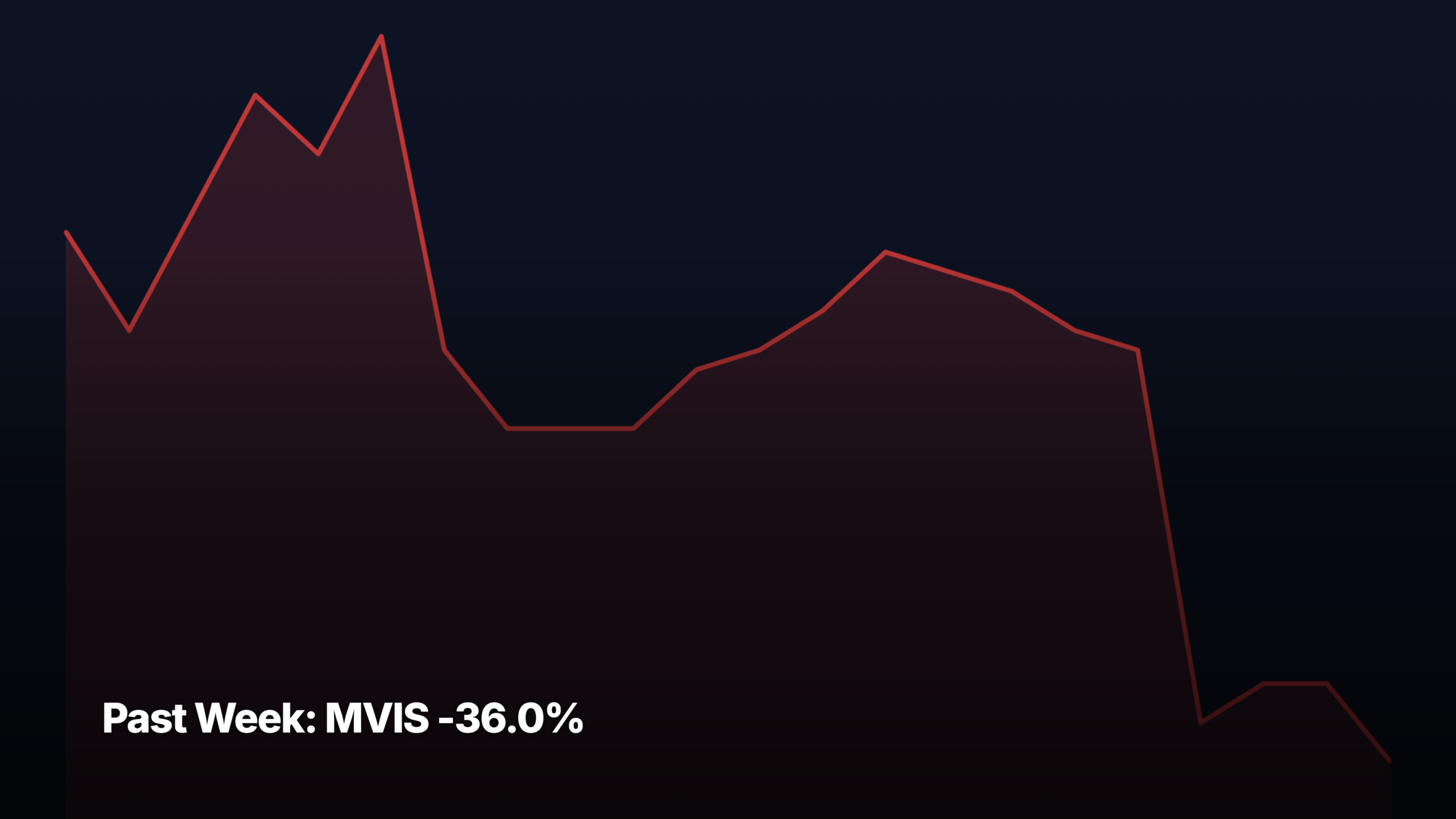
- MVIS -36.0% was the biggest decliner across all cap tiers over the past week through June 5, 2026.
- Top gainer: MDT +10.6% (large-cap). Top decliner: MVIS -36.0%.
- Return spread between the biggest gainer and biggest loser across all tiers was 46.6 percentage points — wide dispersion.
These are the top stock movers for the past week through June 5, 2026, broken down by market-cap tier. MVIS -36.0% was the single biggest move across all four tiers. For each tier, the top 3 gainers and top 3 decliners are listed with a plain-English catalyst note and a pattern-recognition read — whether the move looks like a clean breakout, momentum continuation, mean-reversion bounce, or extended run with reset risk.
Universe: ~145 curated US common stocks (NYSE + Nasdaq, ≥$300M market cap, ≥$1M average daily dollar volume). Cap tier reflects current market cap, not historical.
Mega-cap leaders (above $200B market cap)
Top gainers — past week
1. ↑ ABBV +4.37%
$227.23 · avg $1,230M/day · Mega-cap
Why: AbbVie caught a clean bid as the European Commission approved AQUIPTA for migraine prevention, expanding its neuroscience franchise just as defensive healthcare names attracted rotation flows away from semis. Multiple value screens flagged ABBV trading below intrinsic estimates, reinforcing the bid as risk-off money sought stable cash-flow profiles with a near-term catalyst.
Pattern: Quiet trend continuation rather than a fresh breakout — ABBV ground higher through the week on rising volume without an obvious extension spike. Structure looks orderly, no climactic candle, room to push the prior swing high before reset risk.
2. ↑ JPM +4.36%
$312.37 · avg $2,587M/day · Mega-cap
Why: Money-center banks rallied as stronger-than-expected May jobs data pushed Treasury yields higher and revived 2026 Fed hike bets — a steeper curve directly lifts JPM’s net interest income outlook. Dimon’s public praise of Musk and a constructive JPM note on Tesla added narrative support, but the move was fundamentally a rates-driven repricing of bank earnings power.
Pattern: Stair-step advance off a multi-week base, finishing the week at fresh highs on expanding volume. Looks like genuine accumulation, not exhaustion. No distribution signature yet, but rate-sensitivity cuts both ways if yields reverse.
3. ↑ BAC +4.32%
$53.83 · avg $2,171M/day · Mega-cap
Why: Same rates-up tailwind that lifted JPM — May jobs beat fueled higher long yields, expanding the bank’s net interest margin runway. Bank of America added a company-specific hook with an expansion of its real-time payments network, signaling fee-line growth alongside the NIM story. Bitcoin’s two-year low further rotated risk toward traditional financials.
Pattern: Coordinated bank move alongside JPM and C — base-and-breakout structure clearing prior resistance on volume. Not yet extended versus its 50-day, but the sector is moving as one cohort, which amplifies both upside and reset risk if rates back off.
Top decliners — past week
1. ↓ AVGO -13.66%
$385.73 · avg $21,937M/day · Mega-cap
Why: Broadcom led a semi sector bloodbath as the same hot jobs print that helped banks crushed long-duration growth — Nasdaq dropped 1,100 points on renewed rate-hike fears. Marvell’s S&P 500 inclusion siphoned some marginal AI-trade flow, and Super Micro and HPE weakness signaled the AI infrastructure crowd was getting de-risked into the rate scare.
Pattern: Sharp distribution top — heavy volume reversal off recent highs, broke short-term support cleanly. Looks like trend interruption rather than full breakdown; needs to hold prior consolidation base or the move extends. Oversold bounce possible but structure is damaged.
2. ↓ TSLA -10.28%
$391.00 · avg $18,408M/day · Mega-cap
Why: Tesla sold off with the broader high-beta complex on the rates scare, with added pressure from SpaceX IPO chatter raising questions about how much Musk-premium gets siphoned to the new listing. Skeptical mega-IPO coverage and competing drone/space narratives diluted the Musk halo even as JPM turned more constructive on the equity.
Pattern: Trending decline through the week, no clean reversal bar yet. Broke a near-term support shelf, momentum still pointed lower. Has dropped meaningfully but not climactic — watching for either a capitulation flush or a higher-low setup before assuming the decline is exhausted.
3. ↓ AMD -9.63%
$466.38 · avg $16,437M/day · Mega-cap
Why: AMD fell in lockstep with AVGO and the broader chips sector as the Nasdaq logged its worst day in more than a year. Higher yields hit semi multiples hardest, and AVGO’s leadership unwind dragged AMD with it — when the AI-trade cohort de-risks together, individual fundamentals don’t matter for a week. No AMD-specific negative catalyst.
Pattern: Sympathy distribution with the chip cohort — break of recent trading range on high volume. Pattern looks like the start of a deeper correction unless yields reverse fast. Oversold conditions building but no reversal signal yet on the daily.
Large-cap leaders ($10B to $200B market cap)
Top gainers — past week
1. ↑ MDT +10.65%
$81.67 · avg $1,314M/day · Large-cap
Why: Medtronic was the week’s standout large-cap mover, helped by participation in CereVasc’s $85M funding round (signaling medtech deal activity) plus a wave of positive analyst commentary and a dividend hike. Healthcare defensives caught rotation flows as semis sold off, and MDT specifically benefited from the bullish sell-side cluster around its setup.
Pattern: Clean base-and-breakout on the daily — multi-week consolidation resolved higher with the move accelerating into Friday. Volume expanded on the breakout day. Currently extended versus its 20-day, so some near-term reset risk, but the underlying structure looks early-stage.
2. ↑ PINS +6.83%
$21.42 · avg $452M/day · Large-cap
Why: Pinterest signed a $4 billion multi-year cloud deal with AWS, validating its AI infrastructure investments and tying the platform deeper into Amazon’s ad ecosystem — the dual benefit of capacity plus a strategic Amazon partnership rerated the name. Coverage framing PINS as a quality large-cap under $30 brought additional retail interest.
Pattern: Single-catalyst gap-and-go followed by orderly hold of the gap zone. Not yet extended given the move was news-driven and the prior base was multi-month. If it builds a new ledge above $21, structure remains constructive; failure to hold $20.50 would suggest the catalyst was sold.
3. ↑ C +5.22%
$132.47 · avg $1,556M/day · Large-cap
Why: Citigroup rode the same bank-curve trade as JPM and BAC, with company-specific momentum from a leadership reshuffle aimed at the tokenized deposits push — positioning C in the digital-asset bank narrative even as bitcoin sold off. Strong jobs data driving the 2026 Fed hike bets directly improved C’s net interest margin outlook.
Pattern: Steady weekly grind higher in line with bank peers, finishing near highs. Trend continuation pattern rather than fresh breakout. Not extended, room to run if the rates trade persists, but heavily correlated with JPM/BAC — they move together both ways.
Top decliners — past week
1. ↓ COIN -19.38%
$152.40 · avg $1,742M/day · Large-cap
Why: Coinbase fell hard as bitcoin dropped below $60,000 and hit a two-year low, directly compressing transaction volume expectations and trading revenue. No COIN-specific catalyst — the move tracks crypto-asset prices almost mechanically. Options coverage suggesting bearish spread strategies signals sentiment had already turned skeptical heading into the week.
Pattern: Sharp trending decline, break of multi-week support zone on expanding volume. Looks momentum-driven rather than capitulatory. Pattern says this stays under pressure as long as BTC remains weak; any bounce likely retraces to the broken level before showing whether the down move resumes.
2. ↓ F -14.56%
$14.90 · avg $1,027M/day · Large-cap
Why: Ford fell sharply with no single dominant catalyst — most plausible drivers are the broader rates scare hitting cyclicals plus continued EV-transition pressure as the auto-tech narrative shifts toward space, drones, and AI plays rather than traditional OEMs. Higher rates also weigh on consumer auto financing demand into the back half.
Pattern: Decisive breakdown of recent range on heavy volume — looks more like cyclical risk-off than a fundamental rerating. Now testing longer-term support; pattern suggests either capitulation flush or a base-building attempt. Watch for a reversal bar near $14 before assuming the decline extends.
3. ↓ IREN -14.46%
$54.35 · avg $3,471M/day · Large-cap
Why: IREN gave back gains after a parabolic May run — the prior week’s B. Riley price target hike to $96 on the 800MW South Australia data center deal had pulled the stock up 60% in three months. With bitcoin breaking below $60K and rate fears hitting the AI-infrastructure trade, holders booked profits on the most-extended winner in the cohort.
Pattern: Classic profit-taking pullback after a vertical run rather than fundamental break. Volume tells a holder-rotation story, not a distribution top. If it holds the prior breakout zone in the mid-$50s, the longer-term trend stays intact; failure to hold opens the next consolidation lower.
Mid-cap leaders ($2B to $10B market cap)
Top gainers — past week
1. ↑ KSS +7.66%
$15.46 · avg $89M/day · Mid-cap
Why: Kohl’s bounced on a low base after Q1 earnings, with cautious guidance already digested by the prior selloff. No transformative catalyst — the move looks like an oversold dead-cat bounce plus some short-covering as luxury retail headlines reminded investors of the bifurcation between premium and mid-tier names. Analyst Q&A focused on margin recovery levers.
Pattern: Mean-reversion bounce off a deeply oversold base, low absolute price keeps the move headline-friendly. Not enough volume or follow-through to suggest a real trend change. Pattern looks like a tradeable bounce within a longer downtrend rather than a base completion.
2. ↑ AMC +3.47%
$1.79 · avg $103M/day · Mid-cap
Why: AMC ground higher on strong May theater attendance data and a meme-adjacent reminder that short-seller verdicts (the Hindenburg-related fraud verdict mentioned) thinned the short ranks. The move is modest given the volatility AMC usually shows — suggests retail interest is present but muted versus prior squeeze episodes.
Pattern: Range-bound chop with a slight upward tilt rather than a directional breakout. Low absolute price compresses the percent move. Pattern shows neither distribution nor accumulation conviction — wait-and-see structure until volume confirms either side.
3. ↑ NTNX +3.02%
$53.64 · avg $255M/day · Mid-cap
Why: Nutanix moved up modestly with no specific catalyst beyond Q1 earnings analyst Q&A coverage and inclusion in value-screen articles. The move looks like routine post-earnings drift in an enterprise software name where the rate scare hit higher-multiple peers harder. Defensive software outperformance during a semi-led tech selloff is consistent with this small green print.
Pattern: Quiet trend continuation, slight upward bias but no breakout signal. Volume normal, structure healthy. Among the calmer charts in the cohort — pattern suggests this remains a hold rather than a chase candidate until volume shows up.
Top decliners — past week
1. ↓ LCID -21.91%
$5.11 · avg $88M/day · Mid-cap
Why: Lucid had its worst week with no fresh catalyst — coverage points to deeply-oversold conditions and recent-earnings carryover weakness. EV pure-plays got hit broadly as the SpaceX/drone narrative pulled risk capital toward newer themes and Tesla itself fell 10%. Cash-burn names get punished hardest when rates rise.
Pattern: Trending decline through multi-week support, no reversal bar yet. Now in deeply-oversold territory by most momentum measures, which sets up bounce conditions but doesn’t reverse the trend. Pattern says wait for a higher low before assuming the decline has exhausted.
2. ↓ FCEL -19.99%
$17.33 · avg $184M/day · Mid-cap
Why: FuelCell Energy sold off ahead of earnings after a 137% AI-fueled run-up — classic pre-print profit-taking on a name that had stretched on data center power demand themes. Valuation coverage flagging the sharp rebound suggested holders were trimming before the print rather than waiting to see if the numbers justified the move.
Pattern: Distribution-top characteristics following a parabolic advance — high-volume reversal off the recent peak. Pattern suggests the easy money on this leg is done; whether the broader uptrend resumes depends entirely on the upcoming earnings print and AI power demand commentary.
3. ↓ PLUG -18.61%
$3.21 · avg $262M/day · Mid-cap
Why: Plug Power fell with the hydrogen complex as FCEL’s pre-earnings unwind dragged peers, and tax-credit monetization coverage reminded investors the cash runway story remains the key risk. Hydrogen names got caught between two negative forces — rate-driven selling of speculative cash-burners plus rotation away from green energy toward AI infrastructure.
Pattern: Trending decline with no clear support yet — broke below the recent base on expanding volume. Pattern looks like sector sympathy selling rather than capitulation. Low absolute price keeps percent moves amplified; needs FCEL earnings to set the tone for the cohort.
Small-cap leaders ($300M to $2B market cap)
Top gainers — past week
1. ↑ GME +2.93%
$21.80 · avg $189M/day · Small-cap
Why: GameStop edged higher on renewed Ryan Cohen / eBay deal speculation — coverage framing Cohen as ‘still chasing eBay’ kept the strategic-pivot narrative alive. Despite the broader market selloff into Friday’s jobs print, GME held green on meme-flow plus the corporate action optionality, which is a relative win when the Nasdaq is having its worst day in a year.
Pattern: Small upward drift inside a multi-week range — no breakout, no breakdown. Headline-driven flow rather than trend. Pattern remains chop-and-range; GME tends to wait for a catalyst event before resolving direction, and the eBay narrative isn’t concrete enough yet to trigger a real move.
Top decliners — past week
1. ↓ MVIS -35.98%
$0.39 · avg $5M/day · Small-cap
Why: MicroVision collapsed on reverse-split flexibility coverage that flagged shareholder dilution concerns, combined with the stock hitting a fresh 52-week low alongside other deeply-broken names. At sub-$1 price, headline reverse-split chatter alone triggers forced selling from holders who can’t own sub-$1 stocks, accelerating the move.
Pattern: Capitulation candle on a low-float, low-price name — extreme percent move on relatively thin dollar volume. Pattern shows breakdown structure with no support visible until very low levels. Bounces here are mechanical, not signal — the trend is broken until a substantive catalyst replaces the dilution concern.
2. ↓ SPCE -29.13%
$4.38 · avg $697M/day · Small-cap
Why: Virgin Galactic plunged on a debt-for-equity swap that tested shareholder dilution tolerance, hit further by analyst coverage advocating a ‘betting against space’ trade as SpaceX IPO roadshow chatter pulled flows toward the better-quality name. The whole non-SpaceX space cohort (ASTS, RKLB, SPCE, RDW) sold off together overnight on the dilution and rotation story.
Pattern: Sharp trending decline with breakdown of prior support — combination of fundamental dilution catalyst plus relative rotation makes this a structural break, not a noise move. Pattern looks ugly until either SpaceX IPO clears the supply-of-capital concern or SPCE shows a concrete operating milestone.
3. ↓ BLDP -21.78%
$4.92 · avg $61M/day · Small-cap
Why: Ballard Power fell with the hydrogen/fuel-cell cohort ahead of FCEL earnings — when FCEL gets de-risked, peers like BLDP and PLUG sell off in sympathy regardless of company-specific news. The broader rate scare and rotation away from speculative clean-energy names amplified the move.
Pattern: Trending decline in lockstep with FCEL and PLUG — cohort sympathy break rather than independent signal. Pattern shows momentum down with no reversal candle yet. Watch the FCEL earnings reaction as the tell for whether the whole hydrogen group bounces together or extends.
What the past week cohort tells us
The week’s most striking pattern is the bifurcation between mega-cap value/financials and growth/speculative names. Mega-cap winners were defensive (ABBV healthcare) and rate-sensitive financials (JPM, BAC), while mega-cap losers were the AI-trade leaders (AVGO -13.7%, AMD -9.6%) and Tesla — a textbook risk-off rotation triggered by Friday’s hot May jobs print reviving 2026 Fed hike bets. The leadership signal is clearly value-over-growth and large-over-small: small-caps produced the cohort’s worst drawdowns (MVIS -36%, SPCE -29%, BLDP -22%) with only GME eking out a small green print, while large-cap winners like MDT (+10.7%) and PINS (+6.8%) showed clean catalyst-driven breakouts. Dispersion is wide — a 47-point spread between MDT (+10.7%) and MVIS (-36%) — which signals a regime where macro is dominant but stock-picking still pays at the top end. Notably, three speculative cohorts unraveled together: crypto-adjacent (COIN, IREN), space (SPCE), and hydrogen (FCEL, PLUG, BLDP). The forward observation: if next week’s data confirms the higher-rates regime, expect the mega-cap defensive bid to broaden while speculative small-caps face continued forced de-risking — the kind of cohort behavior that usually persists for several weeks once it starts.
Bottom line
The top stock movers recap covers every US market-cap tier from mega ($200B+) to small ($300M-$2B). The Past Week view shows sustained leadership and sector rotation — complementary to the daily session recap (single-session moves, Tue-Sat morning Melbourne time).
Get early access to Orbit
Orbit is Luna3.ai’s AI-augmented research engine. 12 algorithmic signals + a gradient-boosted ML model + an agentic LLM that reads each top pick’s filings and writes a daily thesis with conviction score and catalyst proximity. Three regimes, three playbooks — growth in expansion, defensives in late-cycle, recovery plays at panic bottoms. The 3 in Luna3.ai.
No spam. Unsubscribe any time.
No comments yet. Be the first to share your thoughts!