
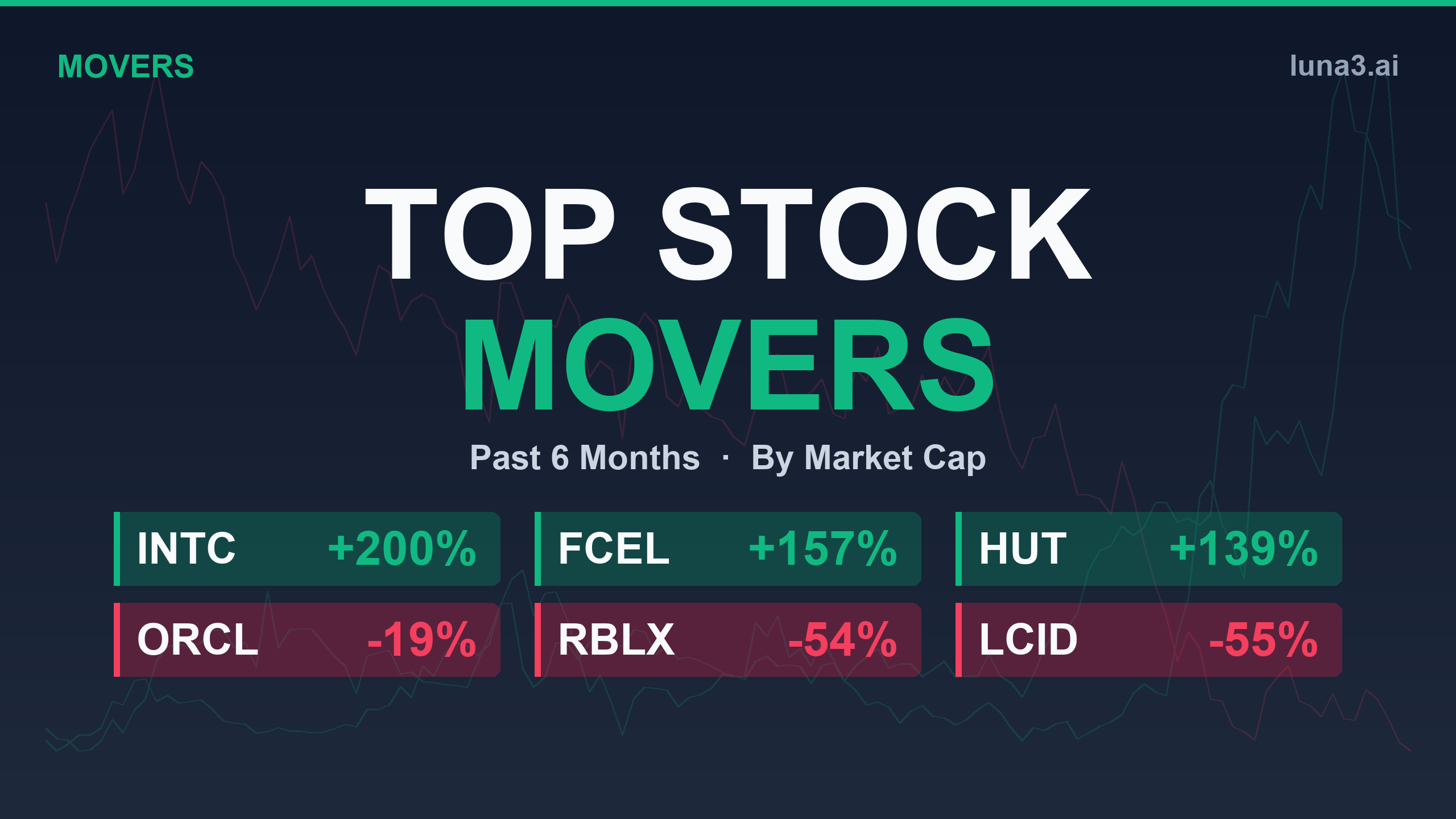
- Past six months (Nov 19, 2025 close → May 19, 2026 close): the semiconductor turnaround was the dominant story — INTC +200% on the Lip-Bu Tan + 18A foundry pivot, TXN +92% on the analog-cycle bottom, AMD +82% on the MI400 ramp.
- The hydrogen / fuel-cell cohort ran hard across two tiers: FCEL +157% (small-cap), PLUG +72% (mid-cap), BLDP +41% (small-cap) — energy-transition story plus on-site data-center power demand fused into one trade.
- The SaaS multiple-compression unwind was broad and real: NOW -37%, INTU -37%, ZS -39%, MNDY -46%, GTLB -41%, ASAN -44%. Even names beating earnings (PLTR rev +85% YoY in Q1) got marked down for valuation, not fundamentals.
This is the past-six-month roundup of top stock movers in the US market, broken out by current market-cap tier — top 3 gainers and top 3 losers per tier across mega, large, mid, and small caps. Twenty-four names, one window (Nov 19, 2025 close → May 19, 2026 close, 124 trading sessions), with the catalyst that moved each and what the cohort tape is telling us about leadership rotation heading into Q3.
Methodology
Universe: ~145 US common stocks with at least $5M average daily dollar volume over the trailing 20 sessions (covers the bulk of investable names; filters out the thinnest microcaps where a 6-month move can be one squeeze + one slow bleed). Returns computed close-to-close on yfinance auto-adjusted prices from Nov 19, 2025 to May 19, 2026. Cap tier is computed at current market cap, not historical — a stock that was small-cap six months ago and is large-cap now (HUT, RIOT) appears in the larger bucket today, because that’s the cohort the reader is screening against now. Several names migrated tiers mid-window as the moves themselves re-priced them up.
Mega-cap top stock movers (≥$200B)
Top 3 ↑
- INTC +199.83% ($35.11 → $105.27). The story of the period. Lip-Bu Tan’s turnaround took hold, the 18A foundry process became the marketing centerpiece for “five nodes in four years,” and an Apple M-series limited foundry contract validated the node externally. Q1 2026 revenue +7% YoY with data center +22%. The stock peaked in the $130s mid-May then pulled back to $105 by May 19 — even after the cooldown, a tripling-from-low. Pattern: breakout-then-pullback off the November bottom.
- TXN +91.67% ($155.28 → $297.63). Texas Instruments rode the analog/embedded chip cycle bottoming late 2025. Inventory finally cleared, auto + industrial end-markets came back, and margin-expansion thesis started showing up in the gross-margin line. The least-talked-about chip mover in the period, which is exactly why it ran — analog isn’t where the hype was.
- AMD +81.65% ($223.55 → $406.08). The MI400 series launched at CES January 2026 (S&P Global projects $7.2B first-year revenue) and Q1 2026 data center revenue grew 57% YoY to $5.8B. The number-two AI accelerator narrative held even as NVDA digested its run. Re-rated as a credible second source, not just a value-priced alternative.
Top 3 ↓
- IBM -21.61% ($284.80 → $223.24). Worst mega-cap loser. Q1 2026 beat on both lines (EPS $1.91 vs $1.81, revenue $15.92B vs $15.62B) and the stock still fell 6% on the print — consulting grew only 4% reported (1% constant-currency), and management maintained full-year guidance instead of raising. The market had priced in an upgrade. The longer-term overhang: as enterprises adopt AI at scale, they pull traditional IT consulting work in-house — IBM’s services moat is structurally exposed.
- PLTR -18.82% ($165.42 → $134.29). Pure multiple-compression. Q1 2026 revenue grew 85% YoY (US commercial +133%), and the stock still fell after earnings. Trades at 46x NTM EV/Rev versus MSFT at 9x. Citi cut its price target $260 → $210 in late April. The fundamentals are not the story; the valuation is the story.
- ORCL -18.64% ($224.15 → $182.38). The “capex correction.” Oracle’s ~$50B FY2026 capex program pushed free cash flow negative and long-term debt above $100B. The stock peaked $345.72 in September 2025 then halved to $152 by mid-March on the spend headlines. The bull case (AI infrastructure landlord) is still intact; the market is just re-pricing how long that spend takes to convert.
Large-cap top stock movers ($10B–$200B)
Top 3 ↑
- HUT +139.40% ($37.54 → $89.87). Hut 8’s pivot from Bitcoin miner to AI/HPC infrastructure platform. The company carved its Bitcoin mining ops into American Bitcoin (now separately listed on Nasdaq) and announced a 15-year, 245MW IT lease at its River Bend campus plus a partnership with Anthropic and Fluidstack for up to 2,295MW of US hyperscale AI buildout. HUT was a small-cap when the period started and is large-cap now — the move itself reclassified it. Cleanest “miner-to-AI-landlord” re-rating of the window.
- AKAM +65.63% ($86.52 → $143.30). Akamai’s security-platform pivot finally inflected. Edge / zero-trust ARR growth accelerated, and the cybersecurity cohort tailwind lifted the multiple. AKAM had been a “value trap” for two years; the period was the moment it stopped being one.
- ASTS +37.48% ($58.01 → $79.75). AST SpaceMobile rode continued sat-comm milestone delivery and the AT&T integration timeline. Rare small-to-large-cap moonshot graduation in a 6-month window — the move itself pulled ASTS from speculative-bet-on-prototype to investable large-cap.
Top 3 ↓
- RBLX -54.27% ($97.37 → $44.53). Worst large-cap loser. Mandatory age verification rolled out in January 2026 created real friction for user growth; engagement metrics softened. Management cut FY26 bookings guidance by $1B (from $8.28–8.55B to $7.33–7.60B) and slashed the revenue guide to $5.87–6.14B against an $8.42B consensus. Daily active users missed the analyst estimate (132M vs 144M expected). A guide-down of that magnitude resets the whole NTM growth narrative.
- SOFI -44.11% ($26.72 → $14.94). Muddy Waters Research published a short report in March 2026 alleging accounting irregularities and inflated profitability. The Galileo banking-as-a-service unit’s revenue fell 27% YoY as a large client off-boarded. Q1 2026 adjusted revenue grew 41% YoY and the stock still couldn’t catch a bid — when the credibility question is in play, growth doesn’t matter until it’s resolved.
- ZS -39.38% ($291.81 → $176.88). Zscaler is the cleanest example of the SaaS multiple-compression cohort — fundamentals not really broken, valuation got marked down with the rest of the high-growth-software universe. SASE momentum continues; the market just isn’t paying 30x sales for it anymore.
Mid-cap top stock movers ($2B–$10B)
Top 3 ↑
- PLUG +72.08% ($1.90 → $3.27). Plug Power led the mid-cap upside on the hydrogen / fuel-cell cohort rally. Two drivers fused into one trade: the standing energy-transition narrative plus on-site fuel-cell adoption by AI data centers (grid interconnects are running multi-year backlogs, so hyperscalers are turning to on-site generation). Cohort confirmation: FCEL +157% in small-cap, BLDP +41% in small-cap — three names, same tape.
- RIOT +65.54% ($13.35 → $22.10). Riot Platforms ran with the Bitcoin tape and added the HPC-hosting optionality story that worked so well for HUT. Riot was small-cap when the period started — like HUT, the move reclassified it. The miner-as-data-center thesis is now a real cohort, not a one-off.
- RNG +59.70% ($26.40 → $42.17). RingCentral’s agentic voice-AI products inflected — AI attach rates doubled YoY to 10% of ARR, the AI Receptionist product launched, integrations with Shopify and Calendly went live. Q1 2026 revenue +5% with margin expansion. The cleanest “AI re-rates a legacy SaaS” story of the window: low expectations, real attach, and the valuation discount that prior multi-year stagnation had created became the setup for the move.
Top 3 ↓
- LCID -55.09% ($12.47 → $5.60). Worst mid-cap loser. Lucid pre-announced Q1 2026 revenue at $280–284M versus $434M consensus, an operating loss near $1B, and only $700M of cash. The follow-on $1.05B capital raise ($300M stock + $550M from Ayar Third Investment) shored up the runway but at the cost of massive dilution. The chart shape is “stair-step lower on each dilution event” — five visible legs down over the period.
- MNDY -46.48% ($148.92 → $79.70). monday.com is the textbook expression of the SaaS multiple-compression cohort. Revenue growth decelerated; the market punished any deceleration relative to the NTM hockey stick that prior multiples assumed. Cohort-wide: GTLB -41%, NOW -37%, INTU -37% in adjacent buckets.
- ZG -44.41% ($66.85 → $37.16). Zillow got hit twice. Q1 2026 EBITDA guidance ($160–175M) missed the $183M consensus, and the broader “AI scare trade” — fear that horizontal AI platforms disrupt the marketplace model — re-priced the multiple. Down 53% from recent high. The marketplace-defense story versus AI-native disruptors is now Zillow’s bull case to make, not a default.
Small-cap top stock movers ($300M–$2B)
One note before this section: the small-cap qualified universe is unusually thin right now (only 11 names cleared the liquidity + cap floor) because so many former small-caps were reclassified up to mid or large during the period — HUT, RIOT, ASTS, KEEL, ONDS, CIFR all migrated up on their own moves. So the “top 3 small-cap movers up” leaderboard reads weaker than you’d expect from a six-month window; the up-side is heavily concentrated in the fuel-cell cohort, and almost everything else is negative.
Top 3 ↑
- FCEL +156.52% ($6.52 → $16.73). FuelCell Energy led the small-cap upside on the hydrogen rally. The Torrington facility is scaling toward 350MW per year of annual fuel-cell production capacity, and AI data center power demand has validated the high-temperature carbonate platform (50%+ efficiency, generates electricity + heat + hydrogen simultaneously). One-month performance through mid-May: +128%. Pattern: oversold-bottom reversal with cohort confirmation.
- BLDP +41.23% ($2.85 → $4.03). Ballard Power Systems rode the same hydrogen cohort tape. Lower magnitude reflects the more-diluted setup at BLDP’s market cap — the rally is real but BLDP starts from a heavier float.
- JBLU +7.56% ($4.10 → $4.41). The only positive airline in the small-cap qualified universe, and the third-best small-cap mover overall — which tells you how negative the small-cap tape was over the window. A modest +8% is the small-cap “top 3 up” bar in this period; that’s the data finding, not a flaw in the universe.
Top 3 ↓
- ASAN -44.25% ($12.01 → $6.70). Asana joined the SaaS multiple-compression cohort at the small-cap end. Workflow / project-management software is exactly the segment where “are AI agents going to displace this?” is the cleanest case to make, and the market is pricing skepticism into the multiple.
- BBAI -35.47% ($5.84 → $3.77). BigBear.ai — the speculative-AI cohort got marked down hard once the broader AI-revenue-actually-materializing question entered the conversation. Customer concentration and execution concerns compounded; the small-cap AI names that don’t have a credible enterprise pipeline are getting separated from the names that do.
- AMC -34.37% ($2.13 → $1.40). The meme-stock fade finally caught up with the equity dilution overhang. Box office headwinds layered on top. The structural story for AMC has been “the equity is a residual claim on a brand,” and the market is pricing what residual means.
What this tells us
Three structural reads from the six-month tape.
The semiconductor turnaround was the dominant theme. Three mega-cap chip names in the top-3-up bucket (INTC +200%, TXN +92%, AMD +82%) and zero in the bottom-3 is the cleanest cohort signal in the data. The mix is interesting: INTC is a structural turnaround (foundry pivot), TXN is a cyclical bottom (analog inventory clearing), AMD is a secular growth story (MI400 ramp). Three different drivers — same cohort outcome. When you see that, the read isn’t “buy chips”; the read is “the chip cycle was the biggest tape in the period and stocks across the sub-categories got rewarded for it.” The follow-up to watch: do those three diverge in Q3, or does the cohort stay intact?
The SaaS multiple-compression unwind is real and broad. Six high-growth-software names in down-leader buckets across three tiers — NOW -37%, INTU -37%, ZS -39%, MNDY -46%, GTLB -41%, ASAN -44%. That’s not a single-company problem; that’s a sector-wide repricing of what enterprise software is worth at 30-50x sales when AI-native competitors are pitching to the same buyers at a tenth of the valuation. PLTR’s situation is the same dynamic at a higher multiple — even +85% YoY revenue growth couldn’t override the multiple correction. The market is asking software companies to grow into 2024-vintage valuations; the ones that can’t are getting cut.
Hydrogen / fuel cells are no longer just an energy-transition trade — they’re now an AI data center power trade. FCEL +157%, PLUG +72%, BLDP +41% in the same window is a cohort move. The reason it ran isn’t “ESG is back”; it’s “hyperscalers are looking at multi-year grid interconnect backlogs and saying yes to on-site fuel-cell generation as a bridge.” That’s a fundamentally different demand stack than the prior 2020-2023 hydrogen cycle, and it shows up cleanest in FCEL’s commentary on the Torrington capacity expansion. If you wanted one chart to take into Q3, it’s the fuel-cell cohort’s relative-strength line versus the broader clean-energy ETF — that’s where the AI-infrastructure spillover is most visible.
For the past-week view that fed into this six-month picture, see Monday’s weekly top stock movers post. For the screener that filters this universe down to a curated watchlist of setups, see the Luna3 setup screener (key-gated). The daily mover archive lives at /category/movers/.
Get early access to Orbit
Orbit is Luna3.ai’s AI-augmented research engine. 12 algorithmic signals + a gradient-boosted ML model + an agentic LLM that reads each top pick’s filings and writes a daily thesis with conviction score and catalyst proximity. Three regimes, three playbooks — growth in expansion, defensives in late-cycle, recovery plays at panic bottoms. The 3 in Luna3.ai.
No spam. Unsubscribe any time.
No comments yet. Be the first to share your thoughts!