- Short selling means borrowing shares, selling them now, and buying them back later — hopefully cheaper — to keep the difference.
- The risk is lopsided: a normal stock can only fall to zero, but a short position can lose far more, because there is no ceiling on how high a price can rise.
- A short squeeze is when a climbing price forces shorts to buy back all at once — the feedback loop behind GameStop's 2021 surge.
Short selling explained in one line: it is a bet that a stock’s price will fall. Instead of the usual buy-low-then-sell-high, a short seller flips the order — they sell first at today’s price, then aim to buy back later for less and pocket the difference. The mechanic sounds simple, but it carries a risk an ordinary stock purchase never does: the gains are capped and the losses are not. Sell a stock short at $50 and buy it back at $30, and you have made $20 a share. But if it climbs to $80 instead, you are down $30 — and nothing stops it from going higher. That asymmetry is the whole story, and it is why short selling jumped from niche concept to front-page news when a video-game retailer called GameStop nearly broke a hedge fund in 2021.
Why this matters
Most investing is optimistic by default — you buy something because you expect it to go up. Short selling is how the market expresses the opposite view, and that matters more than it first sounds. Without short sellers, a stock’s price would only ever reflect the people who believe in it; the skeptics would have no way to put real money behind their doubt. Short selling lets pessimism into the price, which is part of what keeps markets honest.
You have probably bumped into the idea without noticing. When a stock has high “short interest,” that is the slice of its float — the shares actually available to trade — that is currently sold short. When a headline says a hedge fund “blew up,” a bad short is often why. And in January 2021, short selling stopped being a technicality and became a national story: GameStop’s short interest had reached roughly 140% of its public float, according to the SEC’s staff report on the episode. More shares had been borrowed and sold than existed to trade freely — a setup that turned out to be combustible.
The honest headline is this: short selling is the one beginner-level mechanic where you can lose more than you put in. Understanding why is the point of the rest of this post.
Short selling explained: borrow, sell, buy back
Strip away the drama and a short sale is three steps.
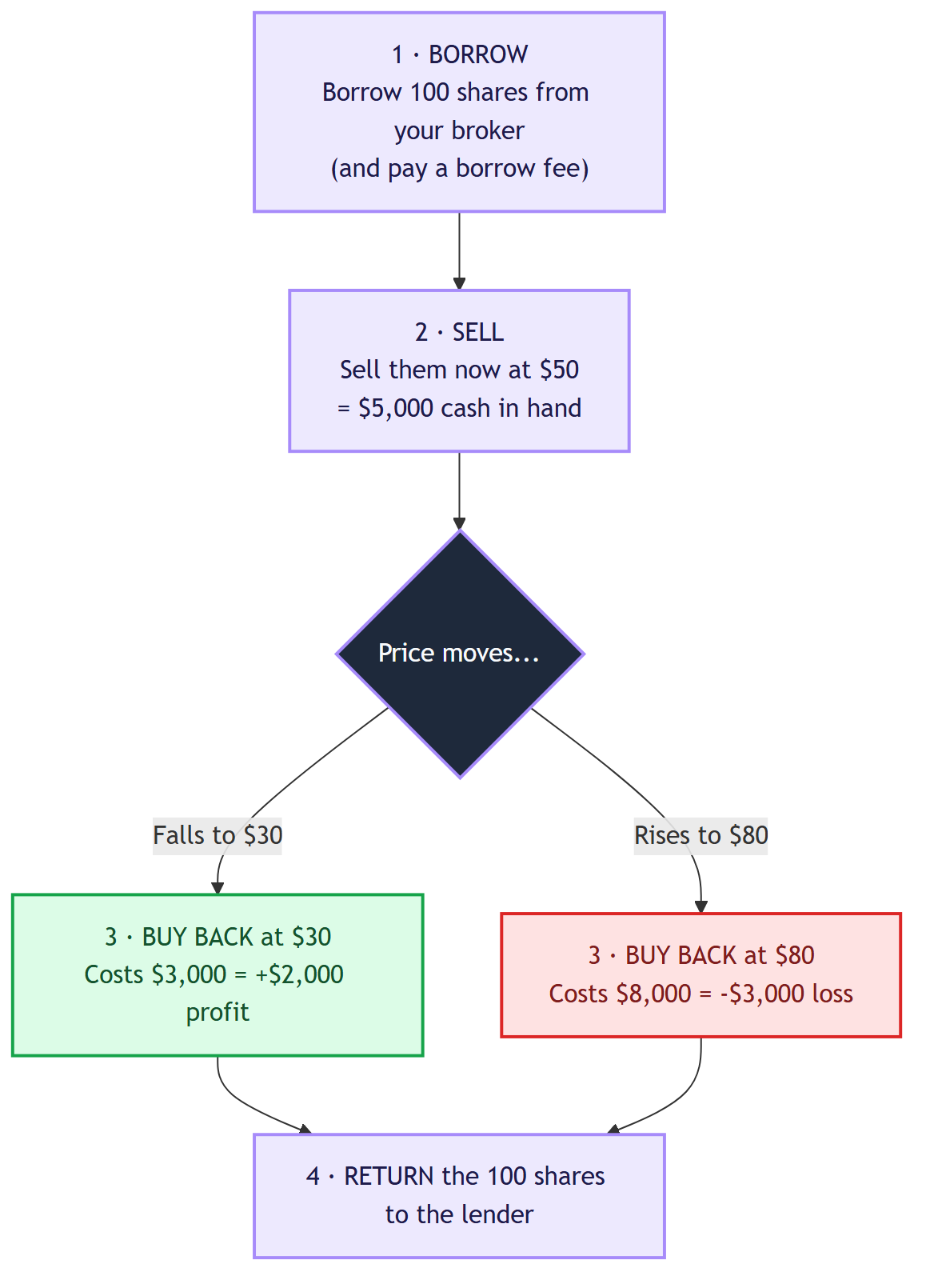
1. Borrow. You do not own the shares you are about to sell, so you borrow them — almost always from your broker, which lends out stock sitting in other clients’ margin accounts. You agree to return the same number of shares later, and you pay a fee for the loan.
2. Sell. You immediately sell the borrowed shares at the current market price. Borrow 100 shares of a $50 stock and sell them, and you now hold $5,000 in cash and an obligation to return 100 shares.
3. Buy back. Later you buy 100 shares on the open market to “cover” — to return them to the lender. Your profit or loss is simply the gap between what you sold for and what you paid to buy back.
If the stock falls to $30, you buy back for $3,000 and keep the $2,000 difference. If it rises to $80, buying back costs $8,000 — a $3,000 loss. Same trade, opposite outcomes, decided entirely by which way the price moved.
The costs beginners miss. Borrowing is not free. Every short pays a borrow fee — the “cost to borrow” — which is trivial for big, liquid stocks but can run to double-digit annualized rates for “hard-to-borrow” names that everyone wants to short at once. You also pay margin interest. And here is the one that surprises people: if the stock pays a dividend while you are short, you owe that dividend to the lender. You are holding someone else’s shares, so any cash they would have collected comes out of your pocket.
The asymmetry that makes shorting dangerous. When you buy a stock the normal way, the worst case is that it goes to zero — you lose 100% of what you put in, and not a cent more. A short inverts that. The best case is the stock goes to zero and you keep everything you sold it for: a 100% gain, capped. The worst case has no ceiling, because a stock can double, triple, or ten-bag, and your loss grows right alongside it. A long position can only fall to zero; a short position can lose more than you ever invested. Both the SEC and FINRA single out this uncapped-loss risk as the defining danger of short selling — and it is not hypothetical. It is close to what happened to the funds shorting GameStop.
The short squeeze that made GameStop famous
A short squeeze is what happens when that unlimited-loss math turns from theory into a stampede. The loop goes like this: a heavily-shorted stock starts rising; the shorts, watching their losses mount, rush to buy shares back to cap the damage; but all that buying pushes the price up, which forces still more shorts to cover, which pushes the price up further. Each round feeds the next.
GameStop in early 2021 is the textbook case. The stock started January around $17. As retail traders on Reddit’s r/wallstreetbets piled in — part turnaround bet, part deliberate campaign to squeeze the funds that were short — GME ran to an intraday peak of about $483 on January 28, 2021 (its closing high was $347.51 the day before). That is the pre-split price; GameStop later did a 4-for-1 stock split in July 2022. Melvin Capital, one of the most prominent funds short the stock, lost roughly $6.8 billion that month — about 53% of its money — and wound down in May 2022.
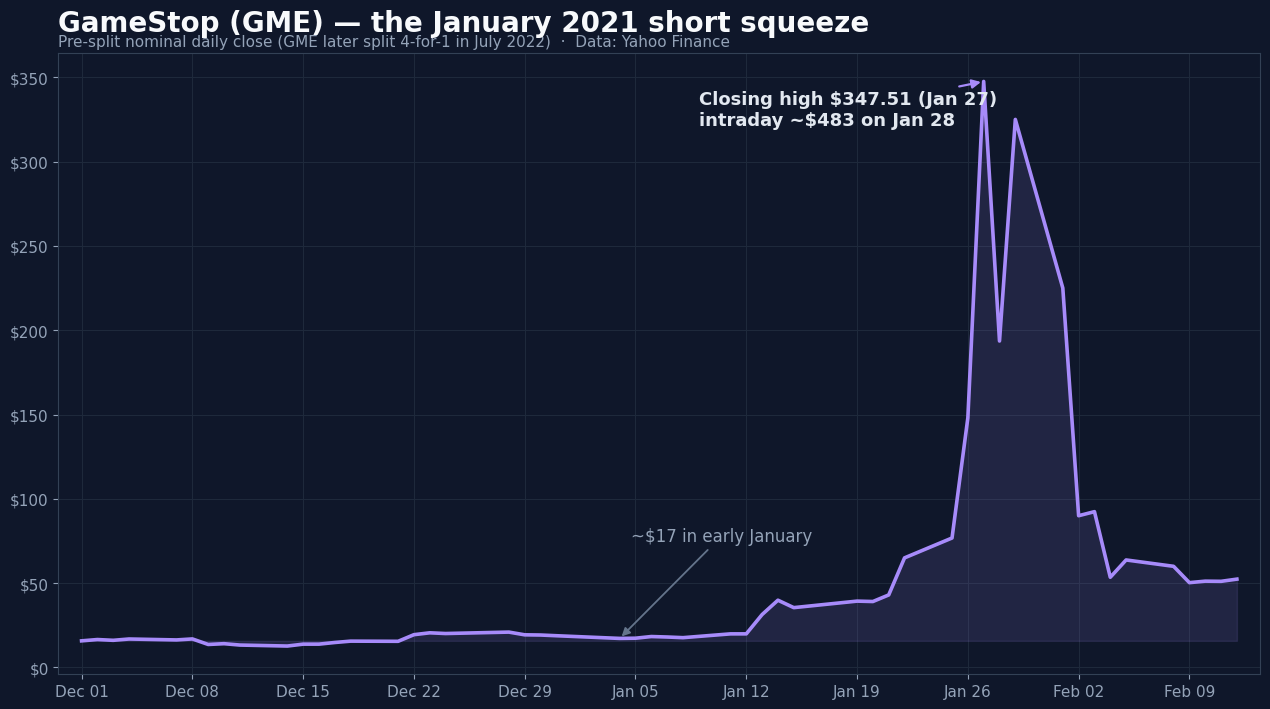

The plain takeaway: the squeeze is why the unlimited-loss warning is not academic. It is the mechanism that turns a losing short into a catastrophic one — and it is most violent precisely when short interest is highest, because there are more trapped sellers who all need to buy at the same time.
Where beginners get confused
A few things trip up almost everyone the first time.
Shorting is not the same as buying a put. Both make money when a stock falls, but a put option gives you a fixed, known maximum loss — the premium you paid for it. A short sale does not. If you want a defined-risk way to bet against a stock, the two are very different animals (the options mechanics are a topic for our Trading pillar).
“Naked” shorting is a separate thing — and mostly off-limits. Legitimate short selling locates and borrows real shares first. Naked short selling means selling shares you have not actually arranged to borrow, and it is restricted under the SEC’s Regulation SHO, whose “locate” requirement says a broker must have reasonable grounds to believe the shares can be borrowed before letting the order through.
There is a brake for falling stocks. Since 2010, the SEC’s alternative uptick rule kicks in once a stock drops 10% in a single day. For the rest of that day and the following session, short sales are only allowed at a price above the best current bid — a guardrail against shorts piling onto an already-collapsing name.
It is not “betting against America.” Short selling carries a bad reputation, but skeptics with money on the line have caught frauds that bullish analysts and auditors missed. Jim Chanos’s firm flagged Enron in early 2001, months ahead of its December 2001 bankruptcy. Muddy Waters published a report alleging fraud at Luckin Coffee in January 2020; that April, Luckin admitted it had fabricated about $310 million of revenue. Pessimism, it turns out, does real work in keeping prices honest.
Going deeper
If short interest and float got you curious, our explainer on market capitalization breaks down how share counts and float actually work. The profit on a covered short is taxed as a short-term capital gain, so that is worth understanding before you ever place one. And because shorts usually target stocks they judge to be overpriced, our walkthrough of the P/E ratio covers how to tell whether a stock is expensive in the first place.
Get early access to Orbit
Orbit is Luna3.ai’s AI-augmented research engine. 12 algorithmic signals + a gradient-boosted ML model + an agentic LLM that reads each top pick’s filings and writes a daily thesis with conviction score and catalyst proximity. Three regimes, three playbooks — growth in expansion, defensives in late-cycle, recovery plays at panic bottoms. The 3 in Luna3.ai.
No spam. Unsubscribe any time.
No comments yet. Be the first to share your thoughts!