- April 2026 set a US ETF inflow record at $167.2 billion — QQQ alone pulled in $10.1B, its best month on record
- May 5 reversed the move: QQQ shed $3.27 billion in a single day; daily flow pace cooled to roughly half of April's run-rate
- Semiconductor ETFs (SMH, SOXX) stayed net positive through May while broad tech flipped — separating structural AI conviction from index-inclusion momentum
April 2026 was the biggest month for US ETF inflows since November 2020. AI ETF inflows hit a record — and then May reversed. The Invesco QQQ Trust shed $3.27 billion in a single session three weeks later, daily flow pace dropped roughly 50%, and the semis cohort started decoupling from broad tech. This is a tracker piece: we map where the $167 billion landed in April, where it came out in May, and which AI-themed funds actually grew AUM versus which ones just rode the broad-tech tide.
April’s $167 billion — where AI ETF inflows landed
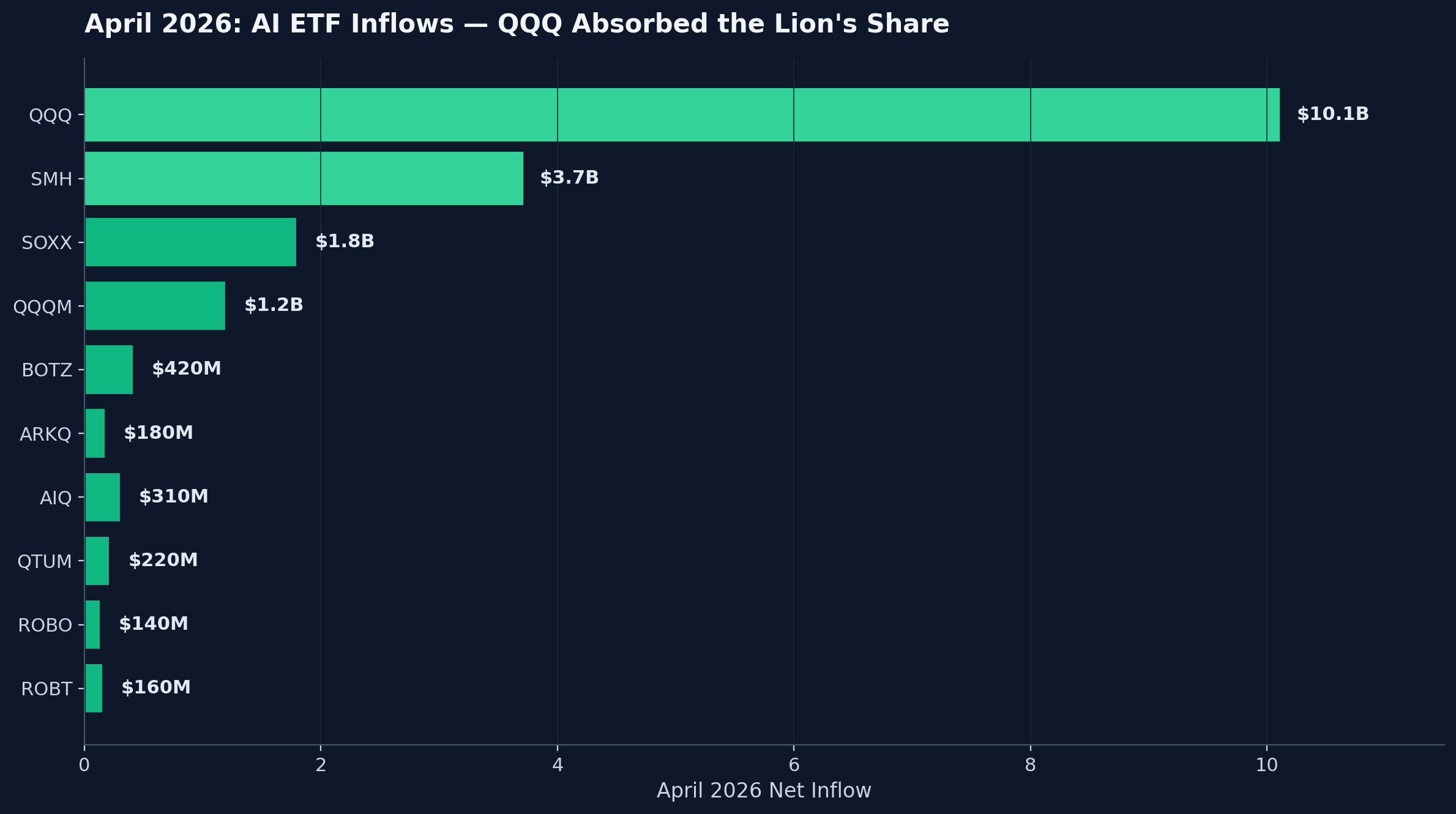
US ETFs pulled in $167.2 billion in April 2026 per Morningstar — nearly three times April 2025’s haul and the strongest single month since the post-election surge of November 2020. The S&P 500 returned its best month in roughly five years. Roughly $100 billion of net new ETF money flowed into just three Morningstar categories: large-blend, large-growth, and technology. AI-tagged conviction concentrated in fund shells that were already the most institutionally-owned.
A few names took the bulk of it:
- QQQ (Invesco QQQ Trust, NASDAQ-100, ~$440B AUM) absorbed $10.1 billion in net inflows — the best single month on QQQ’s record. The fund returned 15.6% in April alone.
- SMH (VanEck Semiconductor ETF, ~$55B AUM) pulled in $3.7 billion while returning 32.2%.
- SOXX (iShares Semiconductor ETF, ~$32.7B AUM) rounded out the chip cohort. Combined SMH + SOXX inflows hit a record $5.5 billion, beating the prior high set in December 2025.
The pattern reads as broad-tech dominance rather than thematic AI conviction. We’ll come back to that distinction.
May’s reversal — the $3.27B QQQ redemption
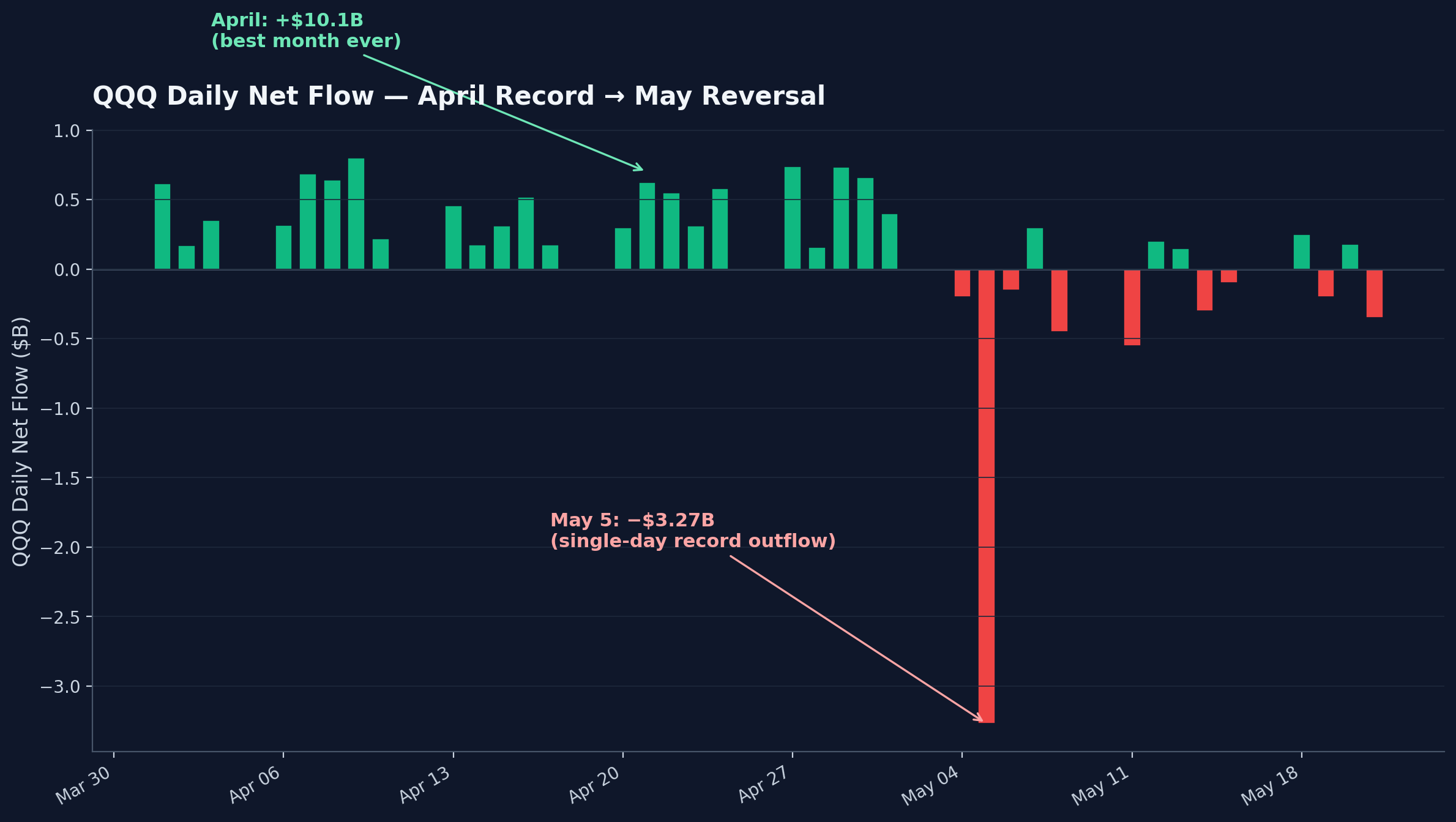
May 5 told a different story. QQQ shed $3.27 billion in a single session per ETF.com’s daily tracker. Total daily US ETF flows that day came in at $9.85 billion across all asset classes — US fixed income absorbed the bulk ($4.85 billion) while US equity slowed to $2.46 billion. AI was no longer the headline driver.
The pattern reads as institutional rebalancing rather than retail capitulation. QQQ’s +15.6% April return triggers mandate-driven trimming for funds running QQQ as a tactical overlay; profit-taking on the largest single-name absorber after a record month is mechanical, not opinion-driven. Daily flow pace through the first three weeks of May has been roughly half of April’s run-rate.
Semis didn’t get hit as hard. SMH and SOXX haven’t shown the same one-day reversals — their flow ledgers cooled but stayed net positive on most sessions. That distinction matters. It suggests the AI-conviction layer is more durable in the chip-supply-chain bucket than in the broad-tech bucket. Same theme, two different shareholder bases.
Pure-play AI vs broad-tech — where conviction actually sat
“AI ETFs” loosely covers anything with AI in the prospectus mandate, but the AUM and flow data say most of April’s surge was broad tech, not pure-AI plays. The thematic cohort:
- BOTZ — Global X Robotics & Artificial Intelligence ETF (~$3.4–3.8B AUM), robotics-tilted basket
- ROBO — ROBO Global Robotics & Automation Index ETF (the original, launched 2013)
- ROBT — First Trust Nasdaq Artificial Intelligence and Robotics ETF (distinct from ROBO; AI-skewed basket, launched 2018)
- ARKQ — ARK Autonomous Technology & Robotics ETF (~$2.23B AUM as of May 8), actively managed
- AIQ — Global X Artificial Intelligence & Technology ETF, launched 2018
- QTUM — Defiance Quantum ETF, tracks the BlueStar Quantum & Machine Learning Index
These funds combined hold less than 5% of QQQ’s AUM. If $10.1 billion flowed into QQQ in April and ~$5.5 billion combined into SMH + SOXX, the pure-play thematic AI cohort got crumbs by comparison — even with strong returns. Invesco’s own QQQM positioning material frames the lower-fee NASDAQ-100 wrapper as the buy-and-hold preference; the trading layer lives in QQQ. Both ate.
The institutional read: mandate-constrained money buys QQQ for AI exposure because it’s the deepest, most liquid wrapper that still satisfies a tech allocation. Retail conviction in specific themes — autonomous vehicles, quantum compute, robotics — shows up in BOTZ, ARKQ, QTUM. The ratio of broad-tech inflows to thematic-AI inflows is the proxy for “how much AI conviction is real vs how much is index-inclusion momentum.”
What the QQQ vs QQQM split tells us
Invesco runs two ETFs on the same NASDAQ-100 basket, and the split between them is the cleanest signal we have of trading vs buy-and-hold conviction:
- QQQ: ~$440 billion AUM, 0.20% expense ratio. Structured as a UIT (Unit Investment Trust) from 1999. Options-deep. Retail and trader favourite. Used by hedge funds running tactical overlays.
- QQQM: ~$82.9 billion AUM, 0.15% expense ratio. Structured as a 1940-Act ETF launched in 2020. Reinvests dividends internally before paying out. Lower fee. Used by buy-and-hold investors and fee-sensitive allocators.
Same holdings. Same returns. Different shareholder base. The same structural distinction matters in the structural differences between ETFs and mutual funds — wrapper choice often signals investor intent better than the underlying basket does. When QQQM grows faster than QQQ on a percentage basis, long-duration money is buying NASDAQ-100 exposure. When QQQ grows faster, fast money is rotating into tech.
April’s pattern showed both layers buying. May’s QQQ outflow suggests the trading layer is unwinding first while QQQM’s fee-sensitive base sits still. That’s a useful early-warning signal: if QQQM also flips to outflows in June, the underlying buy-and-hold thesis is wobbling, not just the trading layer.
What the flow map signals about AI conviction
Three reads from the two-month picture:
- Concentration is the story. April’s $167B record was driven by maybe 20 ETF tickers absorbing the bulk of the net flow. The AI-tagged inflow universe is narrow.
- Semis are stickier than broad tech. SMH + SOXX stayed net positive through May’s first three weeks; QQQ flipped to a record one-day redemption. That separates structural AI exposure (chips, infrastructure, capex beneficiaries — see our semiconductor ETF comparison for how the two largest semi ETFs are built) from index-inclusion momentum (QQQ holding NVDA / MSFT / META at heavy weights).
- Thematic pure-plays remain a side show. BOTZ, ARKQ, AIQ, QTUM combined absorbed a fraction of what QQQ alone took in. The AI ETF universe is dominated by broad-tech wrappers, not specialty themes. That’s a structural feature, not a temporary anomaly — specialty AI funds work best as satellite positions for institutional mandates that already own QQQ as core.
The semis-broad-tech divergence is the most actionable observation. It echoes the supply-chain logic in the AI hardware supply chain: the bottleneck names (memory, foundries, capacity) are where structural conviction lives, while platform names get more sentiment-driven flow.
What to watch in late May and June
Specific signals on the dashboard:
- QQQ daily flow ledger. A return to consistent net inflow within two weeks frames May 5 as a tactical pause. A second outflow week confirms rotation.
- SMH vs QQQ flow ratio. If SMH keeps adding while QQQ sheds, the semis bucket is decoupling from broad tech. That’s a separable bullish read for the chip cohort.
- ARKQ weekly flow. Historically a contrarian retail-sentiment barometer. Inflows into ARKQ when QQQ is bleeding has tended to mark the bottom of a tech reversal.
- Calendar catalysts. The June FOMC decision (June 16–17, with the dot-plot update). Any new AI-themed ETF launches in the next four-to-six weeks. Looking further out, NVDA’s next earnings print (Q2 FY2027) is scheduled for August 26 — the next single-name anchor for the broader AI demand read.
The rotation tells you which layer of the AI trade has structural conviction and which was riding momentum. April’s data captured the peak of broad-tech absorption. May’s QQQ outflow is the first read on what unwinds when the rally pauses. By late June we’ll know whether April was a regime change or a top.
Get early access to Orbit
Orbit is Luna3.ai’s AI-augmented research engine. 12 algorithmic signals + a gradient-boosted ML model + an agentic LLM that reads each top pick’s filings and writes a daily thesis with conviction score and catalyst proximity. Three regimes, three playbooks — growth in expansion, defensives in late-cycle, recovery plays at panic bottoms. The 3 in Luna3.ai.
No spam. Unsubscribe any time.
No comments yet. Be the first to share your thoughts!