- NBA expansion to Las Vegas and Seattle is expected to fetch $7–10 billion per team — a one-time windfall the 30 existing owners split, with zero going to players, because expansion fees aren’t ‘basketball-related income.’
- The Lakers sold at a $10 billion valuation, the largest sports-franchise sale ever — which validates Sportico’s $9.85B mark on the Knicks, the team MSGS actually owns.
- MSGS’s enterprise value (~$9.6B) sits roughly 29% below the $13.5B private value of the Knicks and Rangers. A board-approved plan to split the two teams is the catalyst to close that gap.
NBA expansion to Las Vegas and Seattle isn’t a basketball story. It’s a price tag — somewhere between $7 billion and $10 billion — bolted onto a franchise that doesn’t exist yet, and a quiet re-marking of all 30 teams that already do. On March 26, 2026, the league’s Board of Governors voted unanimously to explore adding the two cities. Months earlier, the Los Angeles Lakers had changed hands at a $10 billion valuation — the largest sale of a sports team in history. Put those two events side by side and the interesting question stops being who lands the Vegas team. It becomes: what is an NBA franchise actually worth, and is there any way to own a piece of one without a billionaire’s checkbook? There is exactly one — Madison Square Garden Sports (NYSE: MSGS), which owns the New York Knicks and Rangers — and it trades for less than the private value of the teams sitting inside it.

The stock last printed $369.96 going into publication on May 30, 2026, up roughly 94% over the trailing twelve months — not because the Knicks suddenly got better, but because every billionaire who overpaid for a rival franchise quietly re-priced the one you can buy on the open market. To see why the gap is still there, start with the number the whole league is now staring at: the expansion fee.
How NBA expansion economics actually work
On March 25–26, 2026, the NBA’s Board of Governors voted 30–0 to explore expansion to Seattle and Las Vegas. The word “explore” is load-bearing: this was authorization to run a process, not a decision to add teams. A binding vote to actually expand to 32 franchises is expected later in 2026, and each round needs 23 of 30 governors. The league is targeting the 2028–29 season for the new teams to tip off.
The reported price is what makes this a finance story: bids are expected in the $7–10 billion range per team. And here is the part most fans miss — that fee doesn’t get shared the way television money does. Expansion fees go straight to the 30 existing owners, split evenly, and are explicitly carved out of “basketball-related income,” the pool that sets the salary cap and guarantees players their ~51% share. Players get none of it. The NFL and NHL structure their expansion the same way. Two teams at $7–10 billion is roughly $14–20 billion divided 30 ways — call it $470–670 million per existing owner (Sportico pegs the figure at $650 million-plus), a one-time, tax-advantaged check that never touches the cap.
There’s a counter-pressure: 32 teams means national media and league revenue split 32 ways instead of 30, thinning every existing team’s slice by about 6%. The math only works if the upfront fee dwarfs the diluted out-years — and at an $8 billion-plus entry price, it clearly does. What underwrites that confidence is the cash flow on the other side. The NBA’s 11-year media deal, running from the 2025–26 season through 2035–36, is worth roughly $76 billion: Disney at about $2.6 billion a year, NBCUniversal at about $2.5 billion, and Amazon Prime Video at about $1.9 billion — near $7 billion annually, roughly 2.6× the prior deal it replaced (Warner Bros. Discovery’s TNT lost its package entirely). Locked national money through 2036 is exactly what lets a buyer underwrite a $10 billion franchise mark. An expansion fee, in the end, is price discovery on a scarce asset with a federally-blessed, revenue-shared, recession-resistant income stream attached. That’s the same scarcity math that pushed NFL minority stakes to a $9 billion mark last year.
Why $10 billion is the new floor
The expansion number didn’t appear in a vacuum. It sits on top of the most aggressive franchise-value reset in the league’s history. In 2025 the Buss family sold the Lakers to Mark Walter’s TWG Global at a $10 billion valuation — the largest sale of any sports team, anywhere, ever. (Walter also controls the Dodgers and, through TWG, the Cadillac Formula 1 team — the same buyer turning up across two of the sports-as-asset-class trades we’ve mapped.) Months before that, the Celtics sold for $6.1 billion, and the Trail Blazers’ $4.25 billion sale to Hurricanes owner Tom Dundon — out of the late Paul Allen’s estate — was approved by the league on March 30, 2026.
| Team / asset | Price or mark | When |
|---|---|---|
| Vegas / Seattle expansion (each) | $7–10B (expected) | Process opened Mar 2026 |
| Los Angeles Lakers (control sale) | $10.0B | 2025 — record |
| New York Knicks (Sportico mark) | $9.85B | 2025 |
| Boston Celtics (control sale) | $6.1B | July 2025 |
| Portland Trail Blazers (control sale) | $4.25B | Approved Mar 2026 |
| New York Rangers, NHL (Sportico mark) | $3.65B | 2025 |
What the comps prove is simple: a marquee, big-market control stake now clears somewhere between $6 billion and $10 billion. Sportico marks the Knicks at $9.85 billion — the top of the league — and the Lakers print doesn’t stretch that number, it validates it. The mechanism is the same four-lever scarcity that drives every trophy-asset class: only 30 (soon 32) franchises exist; the national-media cash flow is locked and growing; there are no forced sellers; and the only reliable source of supply is an estate-tax bill or a family succession fight. Control sales carry a scarcity premium for all of that. The obvious follow-up: if the Knicks alone are worth nearly $10 billion in a control sale, what is the one public vehicle that owns them — plus an Original Six NHL team — actually trading at?
Where the money flows — the case for MSGS
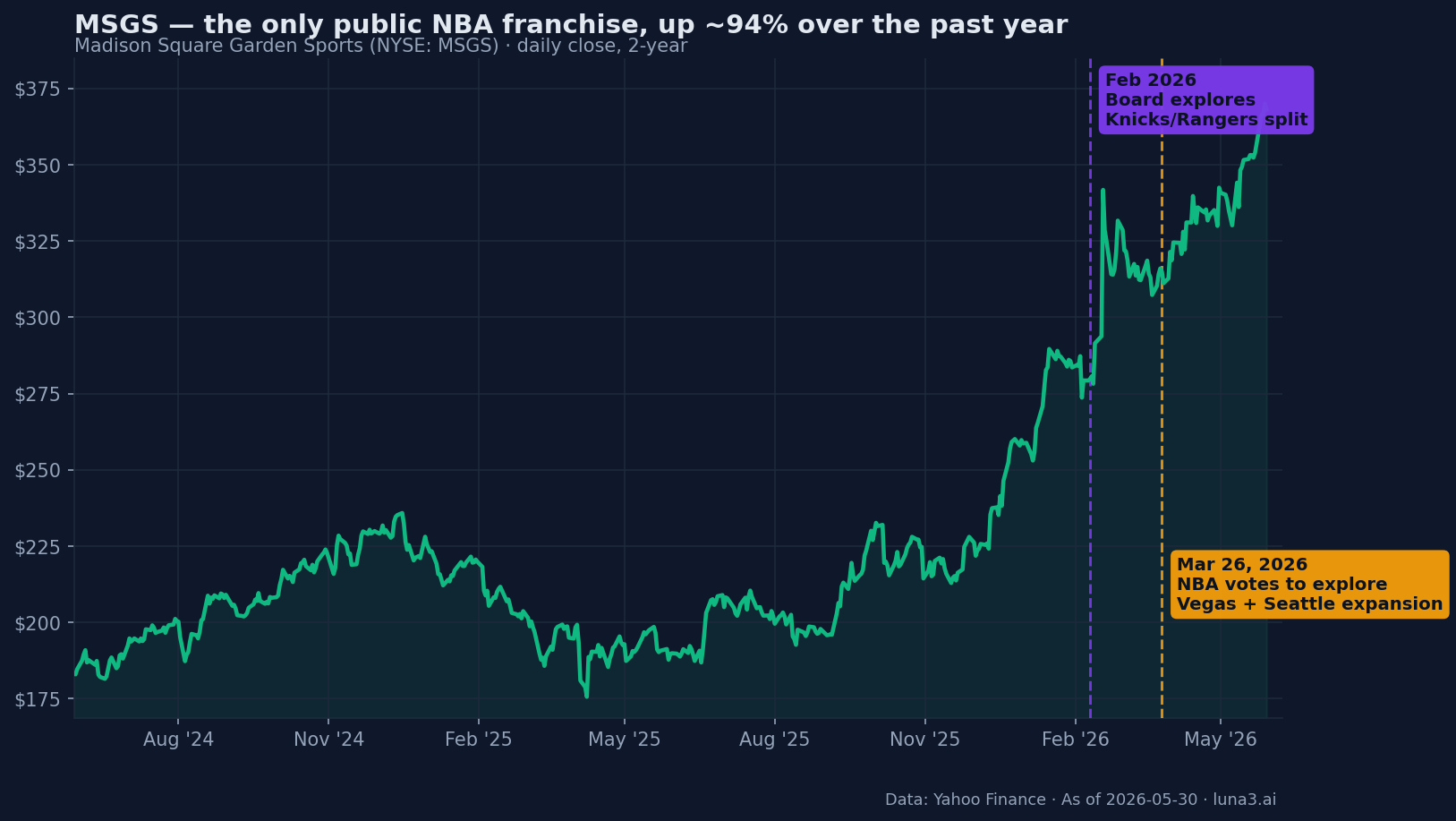
Madison Square Garden Sports is the dominant — and only — pure-play. It owns the New York Knicks and the New York Rangers, and almost nothing else. At roughly $369 a share it carries an $8.85 billion market cap and an enterprise value near $9.6 billion. Sportico values the two teams at $13.5 billion combined — $9.85 billion for the Knicks, $3.65 billion for the Rangers; Forbes puts the pair near $13.75 billion. That leaves MSGS trading at roughly a 29% discount to the private value of its own teams on an enterprise-value basis, and analysts who lean harder on a control-sale comp argue the gap is closer to 40–50%.
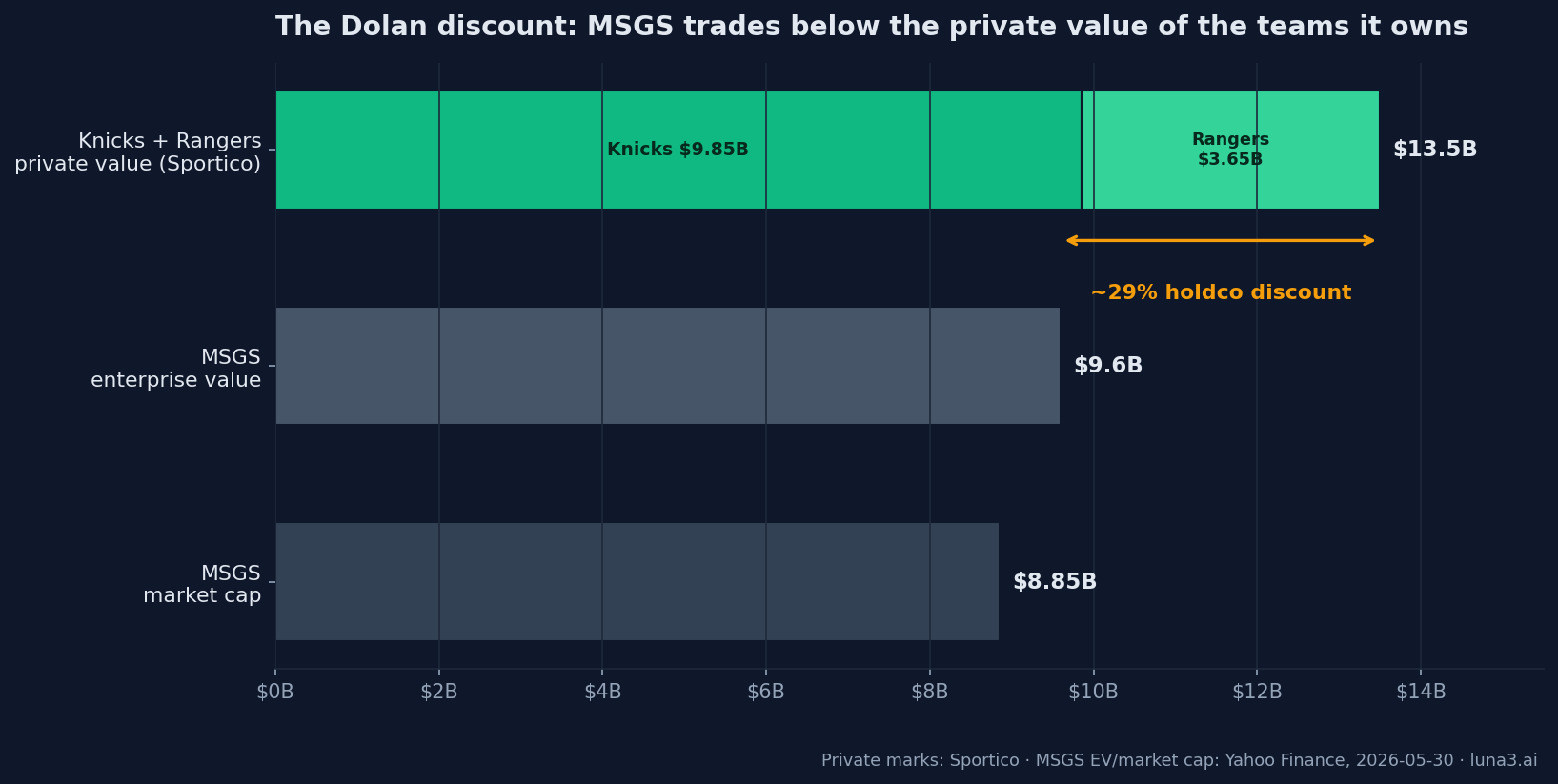
The gap has a name: the “Dolan discount.” MSGS is controlled by the Dolan family through super-voting shares, so a minority public holder is pricing in three real things — no control over the asset, governance entirely in the family’s hands, and a built-in-gains tax that would take a bite out of any actual team sale. Part of the discount is rational; part of it is sentiment. What changed is the catalyst. In February 2026, MSG Sports’ board unanimously approved exploring a split of the Knicks and Rangers into separate public entities — explicitly to give investors a cleaner read on each team and narrow the very gap this chart shows. It’s the first credible unlock mechanism in years.
MSGS isn’t entirely alone — it belongs to a small club of directly-listed sports equities, the “you can actually own it” corner of the market. MANU (Manchester United) is the only directly-listed major football club, at about $3.6 billion. BATRK (Atlanta Braves Holdings) is the only directly-listed Major League Baseball team, around $3.2 billion. FWONK (Liberty Media’s Formula One, near $23 billion) is the league-as-equity play — just as FWONK is the public expression of Formula 1, MSGS is the public door to NBA and NHL franchise value. One name to keep straight: MSGE (MSG Entertainment) is the venues sibling — the Garden building and related properties — not the teams, so it’s not a franchise play.
What about the companies writing the $76 billion media check? Disney, Comcast (NBCUniversal) and Amazon are the counterparties, not the beneficiaries of franchise value. For each of them, NBA rights are a single line item inside a vast business — they underwrite the league’s cash flow, but they don’t capture the scarcity premium that re-rates a franchise from $4 billion to $10 billion. The clean retail expression of franchise value is the team owner, and there is precisely one of those you can buy. You can’t purchase 1% of the Vegas expansion team. You can own MSGS — the public comp that every $10 billion sale and every expansion print re-rates — at a discount, with a self-help split catalyst pending.
The bear case — what could keep the discount open
The honest counter is that the Dolan discount has persisted for a decade, and board-approved exploration of a split is not a split. The process could stall, and even a clean separation doesn’t hand control to minority holders. More fundamentally, a public minority stake is not a control sale. The Sportico and Forbes marks are control valuations; a public shareholder will most likely never see the full $13.5 billion, because of that built-in-gains tax, the absence of a control premium, and the Dolans’ stated intent to hold. A chunk of the gap is structural, not mispricing — the same lesson the NFL minority-stake debate taught, just inverted.
Timing is the other problem. MSGS has already run roughly 94% in a year and sits near its 52-week high; the easy part of the re-rating is behind it, and you are no longer buying it at the lows. Expansion itself cuts both ways — a 30-to-32 split thins every existing team’s share of national media, and if the next media cycle resets flat in 2036 as linear television keeps eroding, that dilution bites harder than today’s models assume. The collapse of regional sports networks (the Diamond/Bally bankruptcies) has already gutted team-level local-TV revenue even as the national deal soared. On the cost side, the NBA’s second-apron penalties and the NHL’s cap pressure squeeze margins, and a high-payroll, high-tax Knicks roster is expensive to run. And franchise multiples are long-duration assets: a broad drawdown in risk and alternative assets could re-price them 20–40% without anything being wrong with the thesis — it would just wreck the entry timing.
What we’re watching
- The binding expansion vote (expected later in 2026) — the actual fee print on the Vegas and Seattle teams. A clear $8 billion-plus number is the re-rate trigger for the entire league comp set.
- The MSGS Knicks/Rangers split — structure, timeline, and tax treatment. This is the company-specific catalyst that either closes the discount or quietly disappears.
- The next control sale — whether $10 billion holds as the marquee floor or was a one-off for the Lakers’ brand.
- MSGS earnings cadence — the buyback pace and any disclosure on the split process.
- The bidder field — the Seattle and Las Vegas groups now forming, almost all of them private, and whether any publicly-listed company turns up in the consortiums.
The bottom line
Strip away the Vegas glamour and the Lakers headline, and what’s left is a quieter story: a small set of scarce, federally-blessed, revenue-shared cash-flow machines are being re-priced in real time, and almost none of them are for sale to the public. MSGS is the rare door left open — discounted, Dolan-controlled, and finally holding a catalyst of its own. Whether that gap closes depends on a split that’s been promised, not delivered, and on a stock that has already done most of the easy work. But the direction of franchise value stopped being ambiguous the day the Lakers cleared $10 billion. The only real question left is who gets to own it.
Get early access to Orbit
Orbit is Luna3.ai’s AI-augmented research engine. 12 algorithmic signals + a gradient-boosted ML model + an agentic LLM that reads each top pick’s filings (like MSGS) and writes a daily thesis with conviction score and catalyst proximity. Three regimes, three playbooks — growth in expansion, defensives in late-cycle, recovery plays at panic bottoms. The 3 in Luna3.ai.
No spam. Unsubscribe any time.
No comments yet. Be the first to share your thoughts!